VIENNA -- Three people die from cardiovascular disease every minute in Europe. That number alone makes the case why the European Commission's Safe Hearts Plan, adopted in December 2025, was long overdue. But a plan is not a pipeline.
From Brussels to bedside
In a session at ECR 2026, Romana Jerković, Member of the European Parliament and rapporteur for the Parliament's cardiovascular health report, put it plainly about where ambition risks colliding with reality. The Safe Hearts Plan identifies the right structural weaknesses like insufficient prevention, late diagnosis, fragmented care, a persistent gender gap and introduces 10 flagship initiatives to address them. But the harder task is implementation.
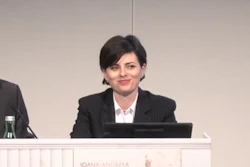
 "If we continue to spend public money treating diseases rather than investing in prevention, we risk getting nowhere," said Romana Jerković.Courtesy of Claudia Tschabuschnig
"Words are not enough," she said. "Strategies, communications and even action plans do not save lives on their own. Implementation does."
While many known lifestyle factors play into cardiovascular health, environmental risk factors such as air pollution, noise exposure, and extreme heat account for more than 18% of cardiovascular deaths across the EU. These are not individual failures, they require regulatory intervention, Jerković argued, and the plan needs to say so explicitly.
Cardiovascular disease remains underdiagnosed and undertreated in women, often because symptoms differ from the male presentation and research has historically been built on male physiology. Sex-disaggregated data collection and sustained funding for gender-specific research are explicit demands in the Parliament's report. So is awareness training for healthcare professionals.
Then came the funding question. EU4Health, the dedicated program, is under pressure. Health is competing with defense, security, and industrial competitiveness in the next multiannual financial framework. The EU allocated more than €4 billion to the cancer plan. Croatia, Jerković's home country, used €9 million of it. "European Union doesn't know how they use that money, unfortunately," she stated.
Ring-fenced funding is the demand: money that goes to health, stays there, and cannot quietly disappear into other priorities or sit unspent in national accounts.
National plans, uneven ground
Piotr Szymański, board member of the European Society of Cardiology and chair of its regulatory affairs committee, pointed to mortality inequalities across member states, a three- to fourfold difference between Western and Eastern Europe, as the clearest argument for coordinated EU-level action. Standalone national plans cannot close that gap.
Cardiovascular disease costs €280 billion annually across Europe. A council recommendation on cardiovascular health checks across member states is in development, with proposals submitted in January. The framework covers different age strata and has been developed in collaboration with European kidney, obesity, and diabetes organizations. The logic is cost-effective triage -- not a Christmas tree, as Szymański put it, but something doable.
Clinical evidence standards for AI tools, developed jointly between imaging and cardiology societies, remain underdeveloped. The medical devices regulation revision and the AI Act both create openings. The European Health Data Space adds another. None of it is coordinated yet.
The calcium gap
 "Coronary calcium is now visible on most of our chest CT scans, but only in the minority of cases we actually report it," said Rozemarijn Vliegenthart, PhD.Courtesy of Claudia Tschabuschnig
Rozemarijn Vliegenthart, PhD, of the University of Groningen in the Netherlands and past president of the European Society of Cardiovascular Radiology, brought the most clinically grounded argument in the room.
Cardiovascular disease kills more Europeans than cancer. Annually, seven million productive life years are lost, and 20% of premature deaths occur in younger patients. Yet there is currently no randomized controlled trial showing that combined screening for cardiovascular risk factors reduces cardiovascular morbidity or mortality, a finding acknowledged by both the WHO and the European Society of Cardiology in 2021.
This is where imaging comes in. The coronary calcium score, derived from a non-contrast, low-dose CT scan, is one of radiology's most validated biomarkers. Any calcium at all doubles the risk of coronary events. A score above 1,000 raises it more than tenfold.
Crucially, calcium score outperforms traditional risk factor counting: individuals with no risk factors but a high calcium score carry genuine cardiovascular risk, while those with multiple risk factors but a calcium score of zero remain at low risk. Data from the Rotterdam study found that up to 47% of statin-naïve adults could benefit from reclassification based on calcium scoring.
The ongoing DANCAVAS trial, with more than 46,000 participants, showed an 11% reduction in all-cause mortality in younger men at five years. The Deutschrobinska trial, with 43,000 individuals including women, is still running.
But Vliegenthart's most pointed observation was about what is already happening and being missed. Millions of chest CTs are performed across Europe each year. Coronary calcium is visible on most of them. "Only in the minority of cases we actually report it," she said.
With lung cancer screening expanding across European countries, the overlap is significant: individuals who qualify for lung screening are typically at intermediate cardiovascular risk or higher. Data from the NELSON trial show that at least as many participants die from cardiovascular disease as from lung cancer. Calcium scoring on these scans costs almost nothing in additional time or dose.
Only a small proportion of radiologists routinely report cardiac findings on chest CTs. The ESR now has a working group developing clinical guidance on exactly this, in coordination with the European Society of Cardiology.
A radiologist from Utrecht raised the ethical dimension directly: if a patient reads their own report and sees an unreported high calcium score, who is responsible? Vliegenthart's answer was unambiguous. "I don't believe it's an ethical problem. I think we have an ethical responsibility: If we see something that should change treatment, we must inform."
Integration, or just intention?
Rodrigo Salgado, president of the European Society of Cardiovascular Radiology, offered the practical bridge. CT adoption in the diagnosis of stable chest pain is already supported by ESC guidelines, backed by landmark trials including SCOT-HEART and DISCHARGE. Neither requires specialist infrastructure: standard CT capability and level 2 cardiac imaging accreditation are sufficient. The infrastructure is already in European hospitals.
"A goal without a plan is just a wish," he said.
What remains is national political will, ESR-ESCR collaboration at scale, and what Szymański described as a media paradox: cardiovascular diseases represent roughly 60% of disease burden but only around 3% of media coverage. The gap between attention and reality is not a clinical problem. It is a communication failure, one that no health plan will fix unless researchers and clinicians bring it to national governments.