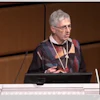
"Imagine you wake up at 4 a.m. hearing explosions in your city. You are a chief of radiology -- and you realize that the war has started," said Yurii Antonenko, MD.Photo courtesy of Claudia Tschabuschnig
"Imagine you wake up at 4 a.m. hearing explosions in your city. You are a chief of radiology, or just a radiologist, and you realize that the war has started. You did not take the threat seriously. And right now your hospital, your radiology department, is not prepared."
That was not a hypothetical. It was the opening of Yurii Antonenko, MD, Chief of the Department of Radiology at Kyiv City Clinical Hospital No. 6 in Kyiv, Ukraine, in a session at ECR 2026. He was describing the morning of 24 February 2022 and opened with a Latin proverb that set the tone for his talk: "Si vis pacem, para bellum. If you want peace, prepare for war."
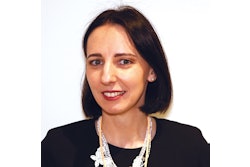
 At the ILC 2022 in London, hepatologists Elina Manzhalii, MD, PhD (left) and Olena Baka, MD, from Kyiv were invited by the Association for the Study of the Liver (EASL) to talk about working in a country at war.Photo courtesy of Andrew McConnell/EASL
The morning of 24 February 2022 has been described from many angles. At the International Liver Congress (ILC) in London that June, hepatologists Elina Manzhalii, MD, PhD, and Olena Baka, MD, both from Kyiv, were still processing it four months later. Missile alerts were arriving on Baka's phone throughout the congress. "We could not hear the planes. We did not know tanks were in the city," she said. A colleague had called to warn her that tanks were heading toward her family's house. "In a few minutes they will be there. I was panicking. Really panicking." She had been on shift at the hospital. The work did not stop. "We did not know what to expect. We prepared to receive patients with severe trauma."
 A field hospital run by Christian NGO Samaritan's Purse in an underground car park near Lviv, 14 March 2022.Photo courtesy of Depositphotos / Bumble-Dee
At ECR 2026, the same determination was still visible. Uliana Pidvalna, MD, PhD, of Danylo Halytsky Lviv National Medical University in Lviv, Ukraine, a recurring voice for AuntMinnie Europe since the invasion began, described in a video interview working through blackouts with backup generators and uninterruptible power supply (UPS) systems, meeting every scientific deadline, traveling to Vienna when there are no commercial flights. More than 250 Ukrainian delegates reached the congress this year.
"We don't need to be isolated. We have to be part of the international community," she said. "Isolation is not an option."
In his talk, Antonenko structured that experience into a clinical framework. His message: the mistakes made in those first hours do not have to be repeated.
What radiology departments are facing
Since the full-scale invasion began on 24 February 2022, WHO has documented at least 2,881 attacks on healthcare in Ukraine, affecting health workers, facilities, ambulances, and medical warehouses. Attacks increased by nearly 20% in 2025 compared to 2024, the highest recorded since the invasion began, according to the United Nations.
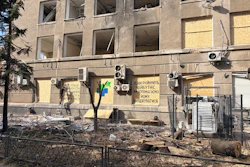
 A civilian building damaged after a Russian missile strike on Kyiv, 25 February 2022.Photo courtesy of Depositphotos / palinchak.
Attacks on medical warehouses tripled in 2025, disrupting supply chains critical to delivering care. As of 24 March 2026, a maternity hospital in Ivano-Frankivsk was damaged in an overnight drone attack involving more than 550 drones.
"More than 800 healthcare institutions have been damaged by ballistic missiles, drones, and cruise missiles since February 2022," Antonenko told the ECR audience.
Geneva Convention Article 18 protects civilian hospitals and staff from attack. "My question is: are the Geneva Conventions really working?" he asked.
Five threats and practical responses
In his talk, Antonenko structured his experience into five threats every radiology department operating under wartime conditions will face.
- Direct attacks. The best solution is a department planned underground from the start. Where that is not possible, relocate equipment inside internal walls, away from external walls and windows. Four principles for radiologists: active leadership; ensuring safety standards are followed by staff and patients; structured patient movement to a safety zone; and local decision-making. "There is no time to call management. You should act here, right now."
- Power outages. The CT scanner is the most energy-demanding piece of equipment in the department. Its x-ray tube draws large electrical power for milliseconds at a time, repeated many times per second, a peak and dynamic load that most backup generators are not sized to handle. A 415-bed hospital with one 250-kilowatt generator, running three operating rooms, an intensive care unit, an oxygen station, one CT, one MRI, and two x-ray units, burns 61 liters of fuel per hour at full load.
The CT scanner may need to be shut down until stable power returns. Ukrainian hospitals are now installing autonomous generators, boiler houses, water wells, and in some cases solar power plants. Satellite internet as backup communications is also essential.
Pidvalna described adjusting her entire working schedule to electricity windows, sometimes only two hours at a time. "You wake up at 2 a.m. to do everything because you have only two hours of electricity," she said in the ECR video interview.
- Lack of supplies. In a frontline city, supply routes can be cut at any time. IV contrast, tubing, syringes, all become scarce. Solutions: prioritize emergency exams; run them without contrast if necessary; reduce contrast dose to achieve suboptimal but usable image quality; reassess whether expired supplies can be used given the circumstances.
- Staff loss. War removes staff through emigration, military conscription, and death. Cross-training is the primary response, teaching x-ray technologists to operate CT scanners, and recruiting ICU nurses with aptitude for imaging. In Ukraine, emergency departments moved to 24-hour shifts, with six radiologists and six technologists covering an entire month of around-the-clock workflow.
- Lack of emergency-specialized radiologists. Not every department has staff trained to read complex trauma imaging quickly
"We are entering really troubling times," Antonenko said. "Irrespective of our subspecialization, we should know the fundamentals of general radiology and emergency radiology."
What war does to the body
Antonenko presented one case from his department: a 40-year-old soldier with a non-healing wound on his foot following a landmine injury. CT angiography revealed early contrast enhancement of veins in the arterial phase, abrupt termination of the distal posterior tibial artery, early venous drainage into superficial veins, and venous reflux to the foot.
Diagnosis: arteriovenous fistula caused by blast trauma. The venous congestion was preventing wound healing. Arteriovenous fistulas, rare in peacetime outside of iatrogenic causes, are a common wartime finding.
The doctors from Kyiv in 2022 observed cascading effects across specialties. Manzhalii and Baka reported increasing cases of decompensated liver cirrhosis, autoimmune disease, and toxic hepatitis, attributed to toxins from munitions entering the air, water, and food supply. Stress manifested as gastrointestinal dysfunction.
"It is a great psychological trauma for all of us," Baka said.
Health needs are increasing
 Ukrainians shelter in an air raid bunker during the Russian invasion, Kyiv, 27 February 2022.Photo courtesy of Depositphotos / Oles_Navrotskyi
"After four years of war, health needs are increasing, but many people are unable to get the care they need, in part because hospitals and clinics are routinely attacked," said Tedros Adhanom Ghebreyesus, PhD, WHO Director-General, in a statement issued on 23 February 2026. A WHO assessment from December 2025 found 59% of people in frontline areas rated their health as poor or very poor. Mental health needs are severe: 72% of people surveyed had experienced anxiety or depression in the previous year, yet only one in five sought help.
WHO has documented 233 health workers and patients killed and 930 injured in attacks since the invasion began. The organization launched a 2026 humanitarian appeal in February requesting $42 million to secure healthcare access for approximately 700,000 vulnerable people, with priority on emergency trauma care and medical evacuations.
Preparedness and partnership
"The burnout after four years of war is immense, and the demand for healthcare has never been higher," said Jarno Habicht, MD, PhD, WHO Representative to Ukraine.
Pidvalna's message to European colleagues was direct. "We like to talk about Ukrainian resilience, about superhuman things," she said. "But we are humans. And it is not okay, in the 21st century, to live in such circumstances."
She asked for three things: gratitude acknowledged, preparedness taken seriously, and partnership extended. "If you see us as partners in your projects, we would like to join."
Antonenko's take-home message was the same as his opening. "Be prepared," he said. "Check your alternative power supplies. Know your emergency radiologists. Develop safety protocols for missile and drone attacks on your department."
In London in 2022, Baka did not hesitate when asked why she had come to the congress despite everything. "Our patients are waiting for us."