
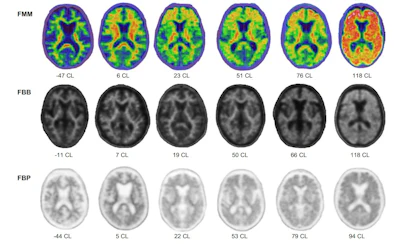
A Spanish study found that choosing different reference regions for amyloid PET scans significantly affects Centiloid scores used to guide Alzheimer's treatment, with the whole cerebellum providing the most reliable and consistent results across different imaging methods and tracers.
- Reference region choice can create differences of more than 20 Centiloids, potentially affecting treatment eligibility decisions
- The whole cerebellum is the most robust reference region across all reconstruction methods and tracers tested
- Pons-based scores were 16.6 to 24.7 Centiloids lower than whole-cerebellum scores for flutemetamol imaging
- Centiloid measurements showed 92% agreement with expert visual readings at a cutoff of 28 Centiloids
- Baseline Centiloid scores remained independently associated with progression to Alzheimer's dementia in clinical follow-up
A Spanish study suggests that the choice of reference region can substantially affect Centiloid-based amyloid PET measurements, with the whole cerebellum providing the most consistent results across tracers and reconstruction settings.
Standardized Centiloid scores are increasingly used to support treatment selection and monitor amyloid-targeting therapies. Variability introduced during image processing could therefore affect clinical interpretation.
The retrospective study, published in the European Journal of Nuclear Medicine and Molecular Imaging, included 162 patients with amnestic mild cognitive impairment who underwent amyloid PET at Clínica Universidad de Navarra in Pamplona, Spain.
First author Katharina C. E. Hirschmüller of the Department of Nuclear Medicine at Clínica Universidad de Navarra and colleagues assessed how image reconstruction and reference-region selection affected Centiloid scores across three fluorine-18 tracers: flutemetamol, florbetaben, and florbetapir.
The Centiloid scale converts tracer-specific measurements of amyloid burden to a standardized scale. It is intended to improve comparability across tracers and processing methods and is increasingly relevant for patient selection and monitoring in amyloid-targeting treatment.
The European Medicines Agency recognizes Centiloid as a qualified biomarker for measuring brain amyloid deposition.
Flutemetamol scores vary sharply
The whole cerebellum was the most robust reference region across reconstruction methods. In patients imaged with flutemetamol, scores calculated using the pons were, on average, 16.6 and 24.7 Centiloids lower than those obtained with the whole cerebellum, depending on the reconstruction method.
Agreement between pons- and whole-cerebellum-based scores was poor for flutemetamol. The authors noted that the pons is largely composed of white matter and that tracer uptake in this region may vary with age. They therefore recommended using the whole cerebellum as a common reference region for Centiloid calculation.
Differences of more than 20 Centiloids could potentially affect eligibility decisions for amyloid-targeting therapies or interpretation of treatment response, although the study did not directly examine changes in clinical management.
The authors also noted that the software’s CE mark and 2024 U.S. Food and Drug Administration clearance did not itself constitute scientific validation of the quantitative metric. They therefore compared automated measurements with expert visual readings and clinical outcomes.
Scores align with visual interpretation
Centiloid measurements showed strong agreement with expert visual readings, with an area under the receiver operating characteristic curve of 0.9786. A cutoff of 28 Centiloids produced concordant visual and quantitative classifications in 92% of cases.
The authors cautioned that this cutoff was used to assess consistency with previous evidence and should not be treated as a universal diagnostic threshold. They also argued that Centiloid may be more useful as a continuous measure than as a simple positive-or-negative classification.
Clinical follow-up was available for 118 patients, of whom 58, or 49%, progressed to Alzheimer’s dementia. Baseline Centiloid score remained independently associated with progression after adjustment for APOE-ε4 status and baseline cognitive performance.
The study evaluated Siemens Healthineers’ syngo.MI Neurology Cortical Analysis platform. Hirschmüller’s doctoral research was funded by Siemens Healthineers, one coauthor was a Siemens employee, and senior author Javier Arbizu reported industry grants and honoraria.
The study was limited by its retrospective, single-center design, relatively small cohort, and uneven representation of the three tracers. The findings support more consistent reference-region and reconstruction choices as quantitative amyloid PET moves further into clinical practice.