
Sustainable cancer care requires more than advanced equipment, it depends on workforce planning, structured training programs, and collaborative regional networks that ensure expertise spreads beyond individual institutions and survives beyond individual trainers.
- Technology alone cannot sustain cancer care; people and organizational structures are essential for long-term success.
- Workforce planning must begin before or alongside equipment investment, with dedicated budgets for training and professional development.
- Competency-based programs, formal accreditation, and structured education make training predictable, scalable, and transferable across institutions.
- Regional networks and collaborative centers prevent islands of excellence by helping other institutions build their own expertise in specialized areas like childhood cancer.
- Industry partners are shifting from equipment suppliers to long-term partners providing sustained education, research support, and locally maintainable technology solutions.
Sustainability is a familiar concept in energy and climate policy and part of the International Atomic Energy Agency’s broader development mandate. The agency supports Member States in using nuclear science and technology to advance the United Nations Sustainable Development Goals (SDGs), including through long-term energy planning. Health is another part of that agenda.
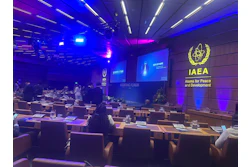
That development agenda framed a later Scientific Forum session on how sustainability could be built into cancer services through the IAEA’s Rays of Hope Anchor Centres. The centers act as regional hubs for training, knowledge exchange, research, and quality assurance, with the idea that expertise should spread beyond individual institutions.
Beyond delivering equipment
“Technology by itself doesn’t cure cancer. People do,” said Dr. Humberto Romano, a clinical medical physicist with Argentina’s National Atomic Energy Commission (CNEA).
Dr. Carmen Margarita Hernández Cárdenas, Director General of Mexico’s National Institute of Respiratory Diseases and a representative of the Mexican Ministry of Health, made a similar point when discussing INCan, Mexico’s National Institute of Cancerology.
“Race of Hope is not about technology or getting infrastructure. It’s about making community,” she said. INCan could use the anchor-center model to expand training, quality programs and professional networks beyond Mexico.
Workforce planning before equipment
Dr. Jamal Khader, a radiation oncologist at Jordan’s King Hussein Cancer Center (KHCC) and Chairman of its Academy for Training and Education, stressed that workforce planning needs to begin before or alongside investment in equipment. Countries could build hospitals and acquire advanced machines, he said, but they also need dedicated budgets and strategies for training the people who will operate them.
KHCC has already applied that approach regionally. Khader described support for Syria following the provision of brachytherapy equipment, including training for the Syrian team, assistance with calibration and treatment protocols, and subsequent virtual mentorship.
Formal training programs
Romano argued that sustainability also requires structured education. Without it, training can depend on “someone with experience” taking a younger professional under their supervision.
“It works, but it cannot be planned. It cannot be scaled. And when that person retires, the program disappears,” he said.
Competency-based programs, defined rotations, and formal accreditation could instead make workforce development more predictable and transferable.
Building networks between centers
For Prof. Emine Serra Kamer, a radiation oncologist at Ege University in Türkiye, the same principle applies at institutional level. Strong centers should not work in isolation but help other centers build their own expertise, particularly in areas such as childhood cancer.
The goal, she said, isn't to copy one successful institution everywhere. It's to build local teams and regional networks, with care models adapted to each health system.
Thailand's Ramathibodi Hospital raised a related point: training should not end when a fellow goes home, because implementation may only begin once that professional returns to their own institution.
Industry representatives also described a shift from equipment supplier to longer-term partner. Aldijana Osmanagic, Head of Business Development and Growth Strategy at Elekta, pointed to training, research and knowledge transfer, while Dr. Ben Newton, Global Head of Oncology at GE HealthCare, emphasized sustained education, simpler workflows and technology that can be maintained locally.