Fibroblast activation protein (FAP)-targeted radioligand therapy has generated enormous excitement, but the first generation of agents has largely underdelivered and the field’s most lasting legacy may be the chemical innovations it produces for other, more promising cancer targets.
That was the message Thomas Hope, MD, of the University of California San Francisco (UCSF), delivered October 18 at the European Association of Nuclear Medicine (EANM) annual meeting.
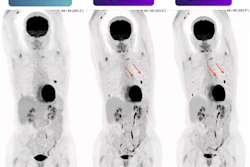
“FAP is awesome,” Hope said. “It is a wonderful diagnostic imaging tool.”
FAP-based PET radiotracers have clean biodistribution, with no salivary gland, liver, or splenic uptake and FAP has pan-tumor appeal, meaning it is overexpressed on cancer-associated fibroblasts across virtually all tumor types.
“If you could make a drug that targets FAP, you could treat all types of cancers,” Hope said. “It could be the pembrolizumab of radioligand therapy.”
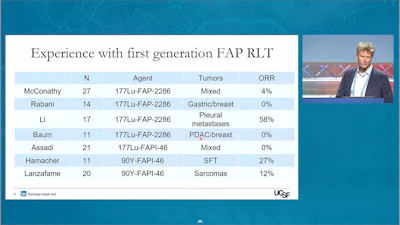
However, early agents showed uptake by tumors in the single digits or low teens and failed to sustain durable tumor binding. Low uptake and a short residence time is not a good combination for radioligand therapy, Hope noted. For instance, phase I results of the LUMIERE trial, which is testing a peptidomimetic compound called lutetium-177 (Lu-177) FAP-2286 designed to improve tumor residence time, have been discouraging, he said.
“Right after the first dose, the majority of patients are progressing,” Hope said. “We’re not getting enough dose to the tumor to slow the tumor down.”
At the root of the problem is that tumor cells and FAP-positive fibroblasts are physically separated by roughly 250 micrometers on average. That gap matters when it comes to radionuclide selection. Yttrium-90 has high-energy electron emission and can deliver an estimated 60% to 70% of its dose across that distance, while Lu-177 reaches only 10% to 15%. Alpha emitters fall furthest short.
“The alpha-emitter does not go far enough to actually treat the tumor cells,” Hope said. “You’re just going to treat the cancer-associated fibroblasts [CAFs] and interestingly enough, CAFs are very radiation resistant.”
Next-generation strategies are exploring using dimers and tetramers to boost uptake, albumin binders to extend intravascular half-life, and covalent warheads for more permanent tumor binding, Hope noted. At UCSF, they have developed a construct called a fibroblast restricted interactive protein (FRIP), which is designed to be activated locally by FAP in the tumor microenvironment. Hope said the approaches looks promising in animal models.
Ultimately, the most important aspect of FAP will not occur in FAP radioligand therapy, Hope said. The innovations and work being done to optimize FAP agents will likely "spill over" to other targets. He cited CA9, GPC3, and ACP3 as more highly overexpressed targets that stand to benefit by FAP research.
“The long run might be that we learn a lot more about chemistry through the investment in FAP that will benefit the field as a whole,” he concluded.