"We are victims of our own success": a punchy line from DRG President Prof. Dr. Christiane Kuhl didn't mince words at RöKo 2026, and the line landed because it hits a nerve. Radiology is the foundation of every modern medical decision given that there is no therapy without a solid diagnosis and no solid diagnosis without imaging. And yet the specialty is fighting for public recognition.
A paradox that the DRG Future Project Radiology 2035 wants to shine a light on. The specialty is simultaneously indispensable and feels threatened. Overload, distance from patients, economic pressure, identity crisis, all consequences of the same success.
The image is getting worse
 "We are victims of our own success," says Univ.-Prof. Dr. med. Christiane Kuhl, President of the German Radiological Society (DRG) and Director of the Department of Diagnostic and Interventional Radiology, Aachen University Hospital.Claudia Tschabuschnig
The image problem is more than just a feeling. The external perception of radiologists as technology-obsessed, patient-distant field, profit-driven, and pure service provider hardens. Kuhl believes this image is partly being actively cultivated by others, to marginalize radiology, downplay its importance, and legitimize cost-cutting.
There used to be a time when there was actual time in the practice to talk with patients. But the sheer volume of cases has made that nearly impossible. Examination volumes double every seven to ten years, with staffing levels remaining flat or shrinking. More speed generates exactly the image the specialty is fighting against.
AI as necessary infrastructure
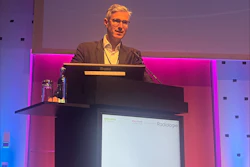
 "Without AI, we can no longer manage our workload," says Univ.-Prof. Dr. med. Thorsten Bley, Director of the Institute for Diagnostic and Interventional Radiology, Würzburg University Hospital.Claudia Tschabuschnig
He pointed to a polytrauma CT in the emergency room that generates 4,000 to 5,000 individual images in seconds. No human can process that in real time. AI shows where to look, it accelerates, but does not replace.
Meanwhile, the demand for care will grow with AI. The core competency of the future therefore lies in curating data, and translating it into clinical decisions. AI literacy becomes a teaching responsibility. Radiologists must learn to assess, steer, and interrogate AI correctly.
In the discussion, AI sounded less like an optional innovation project and more like necessary infrastructure. "AI is my instrument and my willing servant," read one quote from the member survey.
More then a North Star
For the future project, 13,000 DRG members were surveyed, yielding 98 detailed responses. Several breakthrough areas were defined: new care models, AI-driven medicine, medical-technical innovation, training and professional profile, health policy positioning. Time horizon: 10 to 20 years. The implementation plan is the next step.
Methodologically, the future project is ambitious: 50 trends identified, seven scenarios developed, 130 action options condensed to 20, structured according to the Hoshin Kanri principle. A single North Star could not be formulated; the future, as Bley put it, "has never existed before." Three main complexes: steering medical decisions, driving innovation, serving the patient.
Pressure from outside
The real threat is not AI, but the creeping takeover of radiological services by other specialties -- that was the consensus of the discussion. Other disciplines, including cardiology and orthopedics, are increasingly drawing imaging services into their own structures and workflows.
"If we don't own the equipment, we won't have a seat at the table," one participant put it plainly. Whoever owns the equipment does not have to be a radiologist. That is the real power question.
Radiology risks becoming the new laboratory medicine, a pure supplier, without strategic influence, without a voice. "We will disappear from the picture," Kuhl described this scenario as the consequence of a reduced service-provider image.
Data as political capital
The debate is much broader. It is about platform power, workflow control, AI training, ownership. And about who ultimately claims data sovereignty, a discipline like radiology, or the organizations behind it: hospital groups, health insurers, tech platforms.
"Radiology will only remain systemically relevant if it no longer merely generates data, but translates it into clinically relevant decisions," one of the strongest quotes from the entire member survey. Data quality becomes the bottleneck, not data volume. And the capacity for data curation becomes the core competency of the specialty. At its core, this is a Big Tech debate, right in the middle of medicine.
Another quote from the survey made it even sharper: it would be unrealistic to locate data sovereignty within a single clinical discipline. In the end, organizations will claim that sovereignty. As a consequence radiology does not need to own the data, it needs to provide the indispensable expertise for working with it. "Images alone will not make radiology the control center of patient management." Only the integration of clinical and paraclinical findings gives images their actual power.
Need vs. demand
One contentious idea came from Kuhl herself: a large share of imaging does not arise from medical necessity, but from patients' need for reassurance. "Mr. Schmitz, I can imagine your knee hurts," her pointed example of confirmatory diagnostics without therapeutic consequence.
The project's goal is to get away from demand-driven toward needs-oriented allocation. Simply spinning the hamster wheel faster -- more cases, more AI, more efficiency -- is not an answer. Parts of this imaging could, as proposed, be removed from the statutory health insurance system. A structural step, not a technical one.
Not just making images, but treatment decisions
This is where things got lively. A voice from outpatient practice asked bluntly: "What good is AI to me if I'm just going to work more for less money?" And further: "We already image so much unnecessary stuff in outpatient settings, this will just be more of the same." The concern: efficiency gains would be immediately absorbed politically, not as relief, but as justification for further cuts.
Kuhl agreed. That is precisely why the future project is not about running the hare-and-tortoise race faster, but about escaping the spiral altogether.
Another participant noted that certifications and quality evidence are good and necessary, but they do not protect against takeover when the money flows elsewhere. "Professional politics is far more important than constantly looking inward."
"We don't make images. We make treatment decisions." That is the core thesis of the future project. Radiology should no longer stand at the end of the care pathway, but at the beginning. Radiologists as neutral, impartial navigators -- not living off self-referral, but convincing through competence and independence.
Clinical autonomy of the specialty
Early radiological workup could direct patients to the right specialist faster, cheaper, and more precisely. The usual detour through GP, orthopedist, radiologist, back to the orthopedist, it costs months, resources, and nerves.
And: radiology is also therapy. Interventional radiology is no longer a niche topic but a central argument for the clinical autonomy of the specialty. Dedicated outpatient facilities, inpatient capacity, direct patient contact, a clear statement from the member survey.
As a historical anchor: Wilhelm Conrad Röntgen and the image of Anna Bertha's hand. Four weeks after the discovery, a measurable improvement in image quality. Innovation has always been the DNA of this specialty.
"We need to become so good that others come to us with questions, and not just want an image from us," said Bley.
Training: Construction sites everywhere
The training question ran through the discussion too. Broad-based qualification, not only at university hospitals. Trainers who are themselves trained to be good teachers. Structured residency programs that also work in outpatient settings, especially in rural areas, where positions are scarce and structures unclear.
For radiographer (MTR) continuing education, no standardized measurement instrument currently exists. That still needs to be built. Outcome studies as quality evidence, important, but difficult, because too many variables lie between radiological work and patient outcome: surgeons, internists, treatment plans. "We need to find compelling metrics, beyond diagnostic accuracy," said Kuhl. Work is underway.
Visibility as a survival strategy
One colleague from the audience noted: the highest quality is useless if the radiologist stays hidden behind the monitor. Tumor boards, medical chamber committees, guideline commissions, political offices, licensing examinations for international medical graduates, presence is needed everywhere.
Being politically active is not a luxury but an obligation, Kuhl said. Efficiency gains from AI are immediately turned against the specialty politically. Quality offensives do not protect against takeover when the money flows elsewhere.
"We can shape our future, but only if we stop letting others shape it for us."
Our full coverage of RöKo 2026 can be found here.