The "Owl of Athena" represents the ability to see the truth in darkness -- a metaphor for radiologists using imaging to reveal hidden anatomical structures, said European Society of Radiology President Prof. Minerva Becker during the ECR’s opening ceremony on 4 March.
This year's theme for the congress is "Rays of Knowledge," with Athena, the ancient Greek goddess of knowledge and wisdom, as the event's symbol, Becker explained.
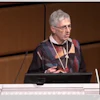
 European Society of Radiology President Prof. Minerva Becker speaking at the ECR 2026 opening ceremony.
“The owl accompanying Athena alludes to the ability to see in the dark and to discern truth and detail under the surface, like in the shadows. Just like radiologic imaging reveals the otherwise hidden anatomical structures and allows us to distinguish between normal and pathologic findings,” she said.
Moments earlier, a throng of attendees was queued up outside Hall A of the Vienna Conference Center, many chatting excitedly. The hall is the largest in the Austria Center Vienna, and it filled quickly ahead of the ceremony, which opened with a dazzling light show and music performed by the Neue Wiener Stimmen Choir and Vienna Art Orchestra -- including a sweeping rendition of "O Fortuna" from Carl Orff's Carmina Burana.
 The Neue Wiener Stimmen Choir and Vienna Art Orchestra performing at the ECR 2026 opening ceremony.
"I am sure that most of you agree that radiology is now at an important crossroads and that it is time to ask ourselves where our discipline is heading," she said.
Some have reduced the radiologist's role to remote image interpretation, and this may be adequate for simple routine tasks, but it falls short for complex cases where clinical context is everything, Becker said.
The growth of the field has compounded the challenge, she added. Imaging volume has surged across Europe, up roughly one-third in Becker’s native Switzerland over the past decade alone, she said, while the radiologist workforce has not kept pace. Moreover, AI has accelerated image acquisition further, and this is adding to an already unsustainable reporting burden.
Becker noted, however, that automated tools could potentially relieve radiologists of high-volume, low-complexity work and free time for more clinically demanding tasks.
Nonetheless, several unresolved concerns about AI integration remain, including questions of human supervision, medical-legal responsibility, the effect on training, and the risk of de-skilling, Becker said.
Becker also directed criticism at hospital administrators and policymakers, warning that a narrow focus on imaging costs obscures the greater expense of diagnostic errors, including misdiagnosis, prolonged hospitalization, and inappropriate treatment. Accurate diagnosis depends on clinical context, she said, which teleradiology settings and standard requisitions frequently fail to provide.
In closing, Becker outlined three priorities for the specialty moving forward: Train radiologists as members of multidisciplinary teams rather than image reporters; build an evidence base around imaging's impact on patient outcomes; and integrate AI into clinical workflows critically and deliberately.
"The time to embrace these strategies is now, and I'm convinced that this can help us lead radiology into a bright future," she said.
Our full coverage of ECR 2026 can be found here.