A missile strike on September 2, 2026, severely damaged the Innova Diagnostica imaging center in Odesa, Ukraine, causing extensive structural damage and disrupting MRI and CT diagnostic services that serve over 5,000 patients annually.
- The attack occurred on September 2, 2026, at Innova Diagnostica in Odesa, Ukraine
- Extensive damage includes shattered windows, damaged walls, and debris throughout the facility
- The facility's MRI scanner's cooling and cryogenic systems suffered major technical problems
- Innova Diagnostica conducts more than 5,000 diagnostic examinations annually in the region
- The imaging center team is working to restore MRI and CT capacity as quickly as possible
Innova D Broken glass and debris cover the floor of a technical room inside Innova Diagnostica. Equipment cabinets and an electronics rack appear exposed and displaced following damage to the building.Mario Taha
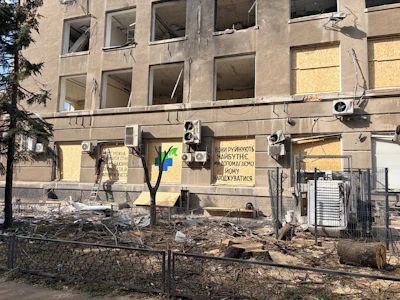
Images from the scene show shattered windows, damaged walls, collapsed ceilings, and debris throughout parts of the facility. According to Dr. Mario Takha, a radiologist and former CEO of Innova Diagnostica, a missile directly struck the building housing the center. The exact weapon that damaged the facility has not been independently confirmed.
The facility was hit early in the morning, before patients had arrived for their scheduled examinations, Takha said. No patients were inside Innova’s MRI or CT departments at the time and no casualties at the imaging center itself have been reported.
Financial loss extends far beyond the scanner hardware
Takha said the center’s MRI examination room and technical room were destroyed or critically damaged. The chiller cooling system, backup diesel generator, emergency power infrastructure, ventilation and climate-control systems, and internal technical and communication networks were also affected.
 An outdoor technical unit behind a protective metal fence shows visible damage to its casing and surrounding structure. The precise function of the equipment should be confirmed with Innova Diagnostica.Mario Taha
“The financial loss extends far beyond the scanner hardware,” Takha said. The MRI system represented years of investment in specialized software licenses, AI reconstruction technologies, Deep Resolve Boost, advanced oncology applications, and customized clinical workflows that made the center’s capabilities unique in southern Ukraine.
Built during wartime
Innova Diagnostica was developed after the beginning of Russia’s full-scale invasion of Ukraine and opened in 2022. According to Takha, approximately €5 million was invested in its imaging equipment, infrastructure, software, engineering systems, education, and clinical workflows.
The center was equipped with a Siemens Healthineers Somatom go.Up CT system and a 1.5-tesla Magnetom Amira MRI scanner. In 2025, the MRI system was upgraded to Siemens’ XA platform and equipped with Deep Resolve AI reconstruction technology.
Takha said Innova subsequently became the first MRI center in southern Ukraine to operate this particular platform. This claim has not been independently verified.
The center’s objective was to establish an oncology-oriented imaging ecosystem rather than simply install new equipment. Its technology included the full Deep Resolve Boost package for accelerated high-resolution MRI and a syngo.via postprocessing environment with licensed oncology applications. Eight server-based syngo.via workstations were available to radiologists and assistants.
The center developed dedicated MRI workflows for prostate, breast, abdominal, pelvic, liver, pancreatic, musculoskeletal, neurological, cardiac, and whole-body oncology imaging. Its radiologists and MRI technologists received extensive training in the technologies and standardized imaging protocols, Takha said.
Specialized care for southern Ukraine
 Mario Taha
Takha said the center performed approximately 1,200 to 1,600 MRI examinations and 1,000 to 1,400 CT examinations each month.
Its main clinical areas included prostate, breast, abdominal, liver, pancreatic, pelvic, and neurological imaging. Takha also described Innova as a leading provider of cardiac MRI in Odesa and southern Ukraine, offering examinations available at few other institutions in the region.
Many oncology patients were referred to Innova because equivalent imaging protocols, AI reconstruction technology, and postprocessing capabilities were difficult to access elsewhere in the region, he added.
“What made Innova special was its people,” Takha said, pointing to the center’s team of radiologists, MRI technologists, engineers, and administrators. Developing the team’s expertise required years of education and investment.
Wider medical complex also damaged
Innova Diagnostica occupied the ground floor of a building that was developing into a multidisciplinary outpatient medical center.
Its partners included Innova Medical, a gynecology and reproductive medicine clinic, and a new vascular surgery center on the second floor. The vascular center had completed renovations and was preparing to open. A neighboring clinical laboratory was also operating there, while new gastroenterology and endoscopy offices were scheduled to open within weeks.
According to Takha, the reproductive medicine clinic was almost completely destroyed, while the unopened vascular surgery center sustained severe structural damage. The laboratory and surrounding medical offices were also heavily damaged.
Innova Diagnostica had additionally been preparing to launch a regional screening mammography project. Takha said the service was intended to strengthen early breast cancer detection in southern Ukraine, where screening remains underdeveloped. The attack interrupted all these projects simultaneously.
More than 1,000 patients affected
Takha estimated that the loss of MRI services immediately affected more than 1,000 patients who relied on the center each month. Odesa has limited capacity for advanced oncology and cardiac MRI, making equivalent replacement services difficult to find, he said.
The Innova team is working with other providers across the city to redirect patients wherever possible.
Reactions on social media also gave a glimpse of how much the center meant to patients. One former patient said she had returned to Innova every three months for contrast-enhanced CT scans after cancer treatment and remembered how much care had gone into the center and the way its staff worked. She said she hoped Innova would be rebuilt and asked whether there was a way to support the center financially.
One crucial resource survived: the patients’ imaging data. Despite the damage to the center’s internal infrastructure, its examination archive and diagnostic database were preserved, according to Takha.
This is particularly important for oncology patients whose earlier examinations are needed for comparison, treatment follow-up, and long-term monitoring.
It is not yet possible to estimate how long reconstruction will take. Before imaging can resume, the center would need to restore its cooling, power, shielding, ventilation, climate-control, communications, and other specialized engineering systems.
“They destroy the future. We help bring it to life”
One photograph from the damaged center shows a message still visible on a A message painted on the facade reads, “They destroy the future. We help bring it to life.”Mario Taha
“For us, it summarizes the role of medicine in Ukraine,” he said. “Missiles destroy hospitals, equipment, and infrastructure. Healthcare does exactly the opposite: We detect cancer before it spreads, diagnose heart disease before it becomes fatal, identify strokes in time, help women become mothers, preserve health, and give people a future.”
After the attack, the words remaining on the damaged wall became an unexpected symbol of resilience for the team. “Innova Diagnostica was built during wartime, and we intend to rebuild it during wartime,” Takha said.
“This is not simply about restoring a building or replacing expensive equipment. It is about restoring access to advanced diagnostics for hundreds of thousands of people in southern Ukraine and protecting years of knowledge, technology, and human expertise.”
“A missile can destroy a building in seconds,” he added. “It takes years to build a team capable of diagnosing cancer, heart disease, stroke, and countless other illnesses at the highest level. That is what we refuse to lose.”
About Mario Takha
Takha is a radiologist from Odesa who previously served as medical director and CEO of Innova Diagnostica. Since March 2026, he has worked as an MRI product specialist at Siemens Healthineers Ukraine, supporting the implementation of MRI technologies and clinical applications across the country.
He began his career in diagnostic radiology and worked in the Middle East from 2004, first as a radiologist and later as head of radiology at a large private hospital.
In 2009, Takha founded Radiographia.ru/org, a Russian-language educational radiology community that brought together radiologists from Ukraine, Kazakhstan, Belarus, and Russia. The platform offered case discussions, imaging protocols, lectures, scientific materials, and opportunities to exchange practical experience.
According to Takha, the professional connections underlying the community were broken after Russia began its military aggression against Ukraine in 2014, and the platform gradually ceased operating in its original form.
Takha and his family had returned to Ukraine in 2012 and settled in Odesa. He subsequently worked as a consulting radiologist before becoming medical director and CEO of Innova Diagnostica, where he sought to develop an imaging center focused on international standards of diagnostic quality, particularly in oncology.
“This is not only the story of one clinic,” he said. “It is also the story of Ukrainian healthcare continuing to function under constant missile attacks.”