The European Society of Head and Neck Radiology (ESHNR) strengthens radiology education through free year-round webinars, online masterclasses, and an international mentoring program that connects radiologists across institutions and countries for clinical and professional development beyond traditional training.
- ESHNR offers free live webinars with CME credits, plus recordings available from 2018 onward, accessible to both members and nonmembers
- An international mentoring program pairs radiologists from their fourth training year onward with mentors across institutions and countries for guidance on clinical work, research, career decisions, and work-life balance
- The first mentoring phase included 33 mentors and 27 mentees from Europe, the U.S., Brazil, India, Australia, and nine other countries, with 88% of mentees reporting the experience was rewarding
- A separate mentoring strand for medical students and junior trainees introduces them to radiology as a clinical discipline and the radiologist's role in multidisciplinary teams
- ESHNR is preparing for its 40th anniversary in 2027 with a webinar series showcasing speakers from across Europe
With its annual congress behind it, the European Society of Head and Neck Radiology (ESHNR) is filling out a year-round program of webinars, an online masterclass, and mentoring and preparing to mark its 40th anniversary in 2027.
Several live webinars are still scheduled for 2026. The live sessions are free, nonmembers included, and each carries one CME credit, the exception being the society's SHINE webinar.
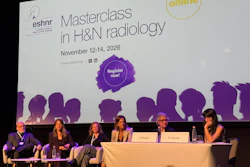
Members can also access recordings going back to 2018. In November, the society holds a three-day online masterclass that pairs lectures with interactive workshops.
Mentoring beyond the reading room
Another focus is mentoring. ESHNR is still recruiting mentors and mentees for a program aimed at radiologists from their fourth year of training onward, plus those in the early years of specialist practice. It covers more than clinical work: mentors also advise on multidisciplinary meetings, research, career decisions, and preparing for the ESHNR diploma.
Participants are matched across institutions and, where possible, across countries. The idea being to give younger radiologists a line to expertise their own department may not have. The society frames it as a complement to local training, not a substitute, and as a two-way exchange rather than a one-way handoff.
The first phase drew 33 mentors and 27 mentees, whose conversations ranged from clinical protocols and multidisciplinary working to networking, leadership, and work-life balance. Eighty percent of mentors and 88% of mentees strongly agreed the experience was rewarding rather than a chore, and every respondent said they would recommend it.
What people actually raised went beyond career advancement. Alongside research and teaching, mentees brought up departmental workflow, strained professional relationships, communication, resilience, and planning a career.
ESHNR looks ahead to its 40th anniversary
ESHNR has since added a separate mentoring strand for medical students and junior trainees, meant to give them a clearer sense of what radiology is as a clinical discipline, the radiologist's place in a multidisciplinary team, and how the specialty shapes patient care.
The reach is deliberately international. In the first phase, mentors and mentees came from across Europe and from the U.S., Brazil, India, Australia, Mexico, Pakistan, Malaysia, Egypt, and Nigeria. ESHNR sees that cross-border mix as a way to spread good practice and widen access to support at the same time.
Then there's 2027, when ESHNR turns 40. The society is planning a webinar series built around speakers from different parts of Europe, meant to showcase the range of people and places the society draws on.