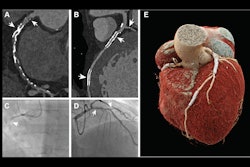
Photon-counting CT sharply improved coronary stent assessment, cutting nondiagnostic stents from 46.8% to 1.1% and showing strong rule-out performance for significant in-stent restenosis in a small invasive-validation cohort.
- Image quality: 70.5% of PCCT stents were excellent vs 23% with conventional CT.
- Far fewer nondiagnostic stents: 1.1% vs 46.8%.
- Strong rule-out performance: 100% sensitivity and NPV in the small invasive-validation cohort.
- Small stents remained evaluable: none under 3 mm was nondiagnostic, though subgroup accuracy is still uncertain.
- Best framed as promising for rule-out: positive findings may still need invasive or functional confirmation.
Photon-counting CT (PCCT) could help overcome one of coronary CT angiography's persistent blind spots: looking inside coronary stents.
Researchers at the Medical University of Innsbruck found that only 1.1% of stents examined with ultrahigh-resolution PCCT were nondiagnostic, compared with 46.8% in a historical control group scanned with conventional energy-integrating detector CT (EID-CT). The study was published on 19 September in European Radiology.
Metallic stent struts produce blooming and partial-volume artifacts on conventional CT, which obscure the in-stent lumen and can make stenosis appear worse than it is. This has limited coronary CTA after percutaneous coronary intervention (PCI).
The 2021 Society of Cardiovascular Computed Tomography consensus considers coronary CTA appropriate in symptomatic patients with stents of at least 3 mm, and more selectively in smaller ones. Photon-counting detectors offer substantially higher spatial resolution, which reduces blooming.
Better image quality across stent sizes
Pietro G. Lacaita, MD, of the department of radiology at the Medical University of Innsbruck in Innsbruck, Austria, and colleagues retrospectively studied 141 patients with previous coronary stenting.
Investigators rated 70.5% of PCCT stents as having excellent image quality, compared with 23% with conventional CT. Only two PCCT stents were nondiagnostic, versus 59 in the EID-CT group.
Small stents also remained assessable. All 28 stents under 3 mm were evaluable, although the study was too small to establish diagnostic accuracy specifically in this subgroup.
Stronger at ruling out than ruling in
 Photon-counting CT correctly identified ≥50% in-stent restenosis in the mid-right coronary artery, which was confirmed by invasive angiography.Lacaita et al., European Radiology, CC BY 4.0.
The researchers also tested whether PCCT could detect in-stent restenosis (ISR) of at least 50% against invasive coronary angiography (ICA). Only 21 PCCT patients underwent invasive angiography, and seven had significant restenosis.
In this subgroup, PCCT showed a 100% negative predictive value, while the positive predictive value was lower at 56.3% per stent.
 Photon-counting CT suggested ≥50% in-stent restenosis because of artifacts, but invasive angiography showed no true restenosis.Lacaita et al., European Radiology, CC BY 4.0.
“PCCT may serve as a reliable non-invasive rule-out test for clinically significant ISR,” the researchers wrote.
Calcification and residual imaging artifacts still produced false-positive findings.
“Positive findings should be interpreted cautiously,” the authors concluded. In difficult cases, invasive angiography or myocardial perfusion testing may still be needed.
Evidence is promising, but still limited
The findings remain preliminary: only seven patients had significant restenosis, invasive angiography was performed in a selected subgroup, and the study was retrospective and single-center. The study also did not establish superior diagnostic accuracy over conventional CT; the direct comparison concerned image quality and evaluability.
The study adds to a growing body of clinical evidence suggesting PCCT may improve coronary stent assessment beyond the image-quality gains already shown in earlier work.
For now, PCCT appears most promising as a rule-out tool after PCI. Larger prospective multicenter studies will need to show whether performance holds across scanners and patient populations and whether better stent assessment ultimately translates into fewer invasive procedures.
The authors reported no relationships with companies whose products or services were related to the study. Open-access funding was provided by the University of Innsbruck and Medical University of Innsbruck.