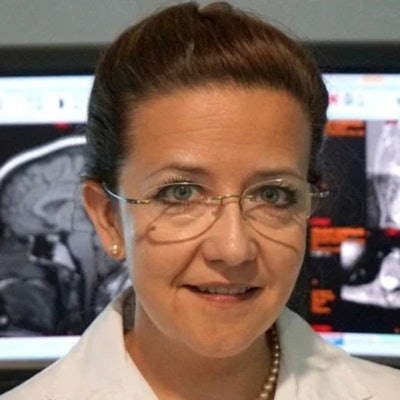
Dr. Fátima Matute Teresa is to become the new minister of health for the Community of Madrid, continuing a recent trend of radiologists being appointed to senior healthcare posts in some European nations.
Details about the appointment were announced by Isabel Díaz Ayuso, president of the Community of Madrid, on the second day of the investiture plenary session at the Madrid Assembly, according to a report posted on 22 June by the iSanidad website.
 Dr. Fátima Matute Teresa. Photo courtesy of SERAM.
Matute is a radiologist at Madrid's San Carlos Clinical University Hospital, where she works in the abdominal section. She is also director of diagnostic imaging at Imagen en Health Diagnostic, part of the Quirónsalud Group, which runs over 70 medical centers across Spain.
She graduated in medicine and surgery from the Complutense University of Madrid in 1998 and completed her residency in radiology at the San Carlos Clinic. Between 2012 and 2018, Matute was general secretary of the Spanish Society of Medical Radiology (SERAM).
In her teaching role, she works as the head of studies at the School of Higher Technicians for Diagnosis and Nuclear Medicine and is a collaborating professor at the Department of Radiology at Complutense University. Additionally, she is the current director of education at the Inter-American College of Radiology.
Matute is vice president of the Spanish Society for Management, Quality and Safety (SEGECA) and editor of the management and quality section of SERAM's Radiología magazine. She is vice chair of the regional committee for Europe of the RSNA and is part of the Quality, Safety and Standards Committee of the European Society of Radiology.
The outgoing minister of health, Enrique Ruiz Escudero, is also a doctor, although he had already been a deputy in the Assembly of Madrid and had held different positions in the Ministries of the Environment and Territorial Planning and the Presidency and Justice, when he arrived at the Ministry of Health in 2017, noted iSanidad. Ruiz Escudero is now taking up a new position in the Senate.
The Community of Madrid is one of 17 autonomous communities of Spain, and it serves a population of over 6.6 million people.