Anatomic discordance and, in some cases, the reader's failure to accurately quantify intermediate stenosis, results in limited per-segment sensitivity for 64-detector-row coronary CT angiography (CCTA), concludes a new study in the August issue of Radiology.
In selected populations at high risk for coronary artery disease, coronary CTA has been shown to have a high negative predictive value for the presence of coronary artery stenosis, wrote Dr. Hervé Gouya and colleagues from University René Descartes Paris and other institutions in France (2009, Vol. 252:2, pp. 377-385).
Yet few studies have examined the diagnostic accuracy of 64-detector-row CT versus invasive angiography, and those that have didn't analyze the reasons for discordance between the two tests.
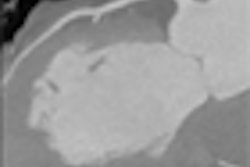
Gouya's prospective study included 114 patients (103 men, 11 women; mean age, 63 years ± 8.2) with potential myocardial ischemia. Coronary CTA was performed on a 64-detector-row scanner (LightSpeed VCT, GE Healthcare, Chalfont St. Giles, U.K.). Two radiologists of unequal experience read the images independently, assessing the diagnostic performance of 64-detector-row MDCT per patient, per artery, and per segment versus coronary angiography.
In all, 68% of patients had stenoses ≥ 50%. Inter-reader agreement was good with k-values of 0.77 to 0.85. On a per-segment basis, the most experienced reader delivered sensitivity of 73.4%, specificity of 95.0%, positive likelihood ratio of 14.7, and negative likelihood ratio of 0.28. On a per-artery basis, this read delivered sensitivity of 95.2%, specificity of 94.7%, positive likelihood ratio of 18.0, and negative likelihood ratio of 0.05. On a per-patient basis, sensitivity was 100%, specificity was 89.2%, positive likelihood ratio was 9.26, and negative likelihood ratio was zero.
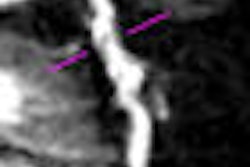
Discordance between 64-detector-row CT and angiography was due to under- or overestimation of the degree of stenosis, anatomic misclassification, and inassessable coronary artery segments at MDCT. A Bland-Altman analysis showed particularly poor agreement for intermediate stenosis (mean bias, 1.3%; 95% limits of agreement: -27.3%, 29.9%).
Despite high diagnostic accuracy on the basis of both per-patient and per-artery, "some stenoses remain misdiagnosed, and this misdiagnosis results in a limited sensitivity at the per-segment level," Gouya and colleagues concluded. Discrepancies between 64-detector-row coronary CTA and angiography "are mostly caused by assignment of a stenosis to the wrong coronary artery segment and poor agreement for quantification of coronary artery stenosis diameter, especially for evaluation of intermediate stenoses."
Additional studies should be conducted in lower-risk cohorts, they wrote.
Related Reading
Lower-kilovoltage coronary CTA maintains image quality, August 5, 2009
Dual-source CTA turns in mixed results for coronary stenoses, July 30, 2009
Prospectively gated coronary CTA nearly equals normal-dose scans, July 17, 2009
Repeated calcium scans increase cancer risk, study finds, July 13, 2009
High-pitch cardiothoracic CTA skips breath-holds and high doses, July 7, 2009
Copyright © 2009 AuntMinnie.com