Congress presidents Prof. Dr. med. Saif Afat (University Hospital Tübingen) and Prof. Dr. med. Daniel Pinto dos Santos (University Medical Center Mainz) welcomed attendees to the opening ceremony under the motto "Radiology without borders."Claudia Tschabuschnig
Dorina Petersen, a freelance radiographer and podcast host of "The Fascination of Radiology," then took the audience on a journey through the history of x-rays -- from Wilhelm Conrad Röntgen's discovery in 1895 through Marie Curie to the darkest chapters of the 20th century, including the abuse of ionizing radiation in war, persecution, and medical experiments in concentration camps.
 Dorina Petersen, freelance radiographer and podcast host, took the audience on a journey through the history of x-rays.Claudia Tschabuschnig
"AI needs the radiographer, not the other way around"
Back to the future led David Rutkevich from the Institute for Artificial Intelligence in Medicine, with a critical look at AI in radiology. Segmentation models like Total Segmentator or multimodality approaches deliver impressive numbers, he acknowledged, accuracies of up to 90 percent, tenfold acceleration in MRI.
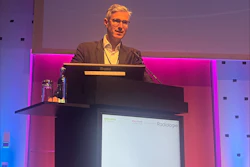
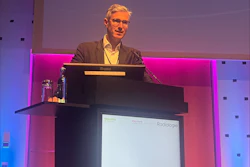
 David Rutkevich from the Institute for Artificial Intelligence in Medicine presented a critical perspective on AI in radiology, titled "Ciao MTR -- welcome AI?"Claudia Tschabuschnig
Even more problematic is the effect on clinical expertise. Rutkevich cited studies showing that nearly 80 percent of all software developers use or want to use AI tools, while programming skills have declined by 70 percent.
In radiology, he observes the same pattern: radiographers increasingly hit "Approve" without knowing what the AI actually did. "These errors are becoming more frequent because people can't just say 'no', or don't know what's wrong."
"AI needs the radiographer, not the other way around," was his closing argument. While AI takes over routine tasks, clinical responsibility and patient care should remain with humans. Their role is shifting: from operator to conductor. And those who shape this process become indispensable, he believes.
The opening was moderated by Claudia Mundry, chair of the German Association for Medical Technologists in Radiology (DGMTR), together with Anton Sheahan Quinsten. Two awards were presented during the ceremony: The DGMTR honorary membership went to Claudia Verloh from Münster, who has shaped training and professionalization in the radiographer profession for decades. The MTR X-ray Prize in the education category went to Jürgen Wameling from Münster for his commitment to radiographer training.