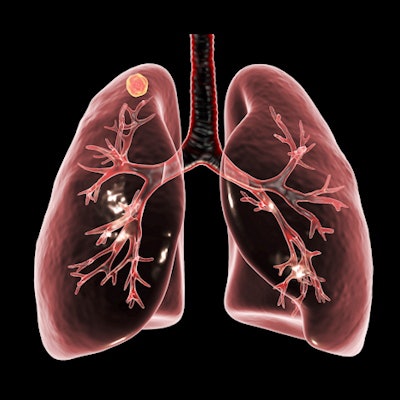
Clinical communications company Feedback has received funding from Amazon Web Services (AWS) to deliver cloud-based tuberculosis (TB) screening services in rural communities in India.
Bleepa, Feedback's tuberculosis screening program, will be hosted on AWS Cloud. The program pushes x-ray images acquired in rural communities without network access straight to the cloud to be shared with specialist clinicians or a suitable AI tool for reporting. The process takes minutes and enables TB screening personnel to initiate treatment while the patient is still in the vicinity, Feedback said.
Images and any clinical reports or discussion are stored in a CareLocker -- a cloud container that stores medical data at an individual patient level -- which could enable the creation of citizen health records that align with requirements of India's National Digital Health Mission, Feedback added.
India experiences an estimated 2.6 million new cases of tuberculosis every year. Chest x-rays are key to screening for the disease, but they require interpretation by radiologists or other specialist clinicians, or a suitably regulated AI technology -- none of which are available in most rural settings in India, Feedback said.




![A normal mammogram confirmed by three-year radiologic follow-up illustrates reader-marked regions of interest (ROIs) during (A) unaided (round 1) and (B) artificial intelligence (AI)–assisted (round 2) reading. Each colored dot represents an ROI for recall by a human reader. Readers could mark more than one ROI per case, represented by multiple dots of the same color. During AI-assisted reading, the AI system displayed three visible prompts: two with suspicion of malignancy scores of 35% (left mediolateral oblique [L MLO] and craniocaudal [L CC]) and one with a suspicion of malignancy score of 10% (right craniocaudal [R CC]), shown as polygonal overlays. Without AI, six of 10 readers (60%) marked a false-positive ROI. With AI assistance, this fell to two of 10 (20%). R MLO = right mediolateral oblique.](https://img.auntminnieeurope.com/mindful/smg/workspaces/default/uploads/2026/07/2026-07-14-radiology-mammogram-ai-auto-bias.H0bYO8QlWs.jpg?auto=format%2Ccompress&fit=crop&h=100&q=70&w=100)


![A normal mammogram confirmed by three-year radiologic follow-up illustrates reader-marked regions of interest (ROIs) during (A) unaided (round 1) and (B) artificial intelligence (AI)–assisted (round 2) reading. Each colored dot represents an ROI for recall by a human reader. Readers could mark more than one ROI per case, represented by multiple dots of the same color. During AI-assisted reading, the AI system displayed three visible prompts: two with suspicion of malignancy scores of 35% (left mediolateral oblique [L MLO] and craniocaudal [L CC]) and one with a suspicion of malignancy score of 10% (right craniocaudal [R CC]), shown as polygonal overlays. Without AI, six of 10 readers (60%) marked a false-positive ROI. With AI assistance, this fell to two of 10 (20%). R MLO = right mediolateral oblique.](https://img.auntminnieeurope.com/mindful/smg/workspaces/default/uploads/2026/07/2026-07-14-radiology-mammogram-ai-auto-bias.H0bYO8QlWs.jpg?auto=format%2Ccompress&fit=crop&h=112&q=70&w=112)