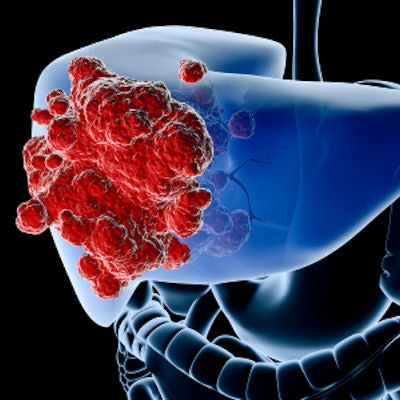
Imaging software developer Median Technologies said that its iBiopsy platform has shown promising results in measuring antitumor immune response, potentially helping to identify patients who are responding to treatment.
In a retrospective study involving 44 patients with primary liver cancer, Median found that the CD8 signature of the deep learning-based iBiopsy platform was a better predictor -- with an area under the curve (AUC) of 0.93 -- of the tumor microenvironment than traditional radiomics methods, which only yielded an AUC of 0.67. What's more, the iBiopsy CD8 signature was also shown to be predictive of patient prognosis, according to the firm.
Median noted that the study findings now need to be confirmed in larger, independent cohorts.






![A normal mammogram confirmed by three-year radiologic follow-up illustrates reader-marked regions of interest (ROIs) during (A) unaided (round 1) and (B) artificial intelligence (AI)–assisted (round 2) reading. Each colored dot represents an ROI for recall by a human reader. Readers could mark more than one ROI per case, represented by multiple dots of the same color. During AI-assisted reading, the AI system displayed three visible prompts: two with suspicion of malignancy scores of 35% (left mediolateral oblique [L MLO] and craniocaudal [L CC]) and one with a suspicion of malignancy score of 10% (right craniocaudal [R CC]), shown as polygonal overlays. Without AI, six of 10 readers (60%) marked a false-positive ROI. With AI assistance, this fell to two of 10 (20%). R MLO = right mediolateral oblique.](https://img.auntminnieeurope.com/mindful/smg/workspaces/default/uploads/2026/07/2026-07-14-radiology-mammogram-ai-auto-bias.H0bYO8QlWs.jpg?auto=format%2Ccompress&fit=crop&h=112&q=70&w=112)


