
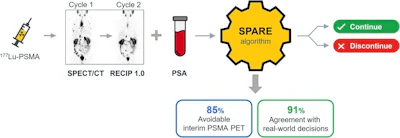
A SPECT-guided algorithm could help decide whether or not to continue lutetium-177 (Lu-177) radiopharmaceutical therapy (RPT) in patients with advanced prostate cancer, according to a study published November 12 in the Journal of Nuclear Medicine.
A group from the Institut Jules Bordet in Brussels, Belgium, developed and tested an algorithm called SPARE (SPECT-guided Algorithm for Radiopharmaceutical therapy Evaluation) after the second cycle of Lu-177 prostate-specific membrane antigen (PSMA) I&T therapy, with findings suggesting it could significantly reduce the need for costly and less accessible PSMA-PET scans.
"A SPECT-guided algorithm applied after 2 cycles of Lu-177 PSMA could have avoided 84.5% of interim PSMA-PET examinations and presented 91% agreement with real-world decisions to continue or discontinue treatment," the researchers wrote.
Currently, there is no standardized approach for deciding when to continue or discontinue Lu-177 PSMA therapy after initial cycles, the authors explained. Prostate specific antigen (PSA) levels are routinely tracked but can lag behind disease progression, they added. Also, while interim PSMA-PET has emerged as a reference response biomarker, repeat PSMA-PET scans are constrained by access and cost, the group noted.
Conversely, posttherapy SPECT/CT is obtained after every cycle without an additional injection, and prior data suggest it approaches the prognostic accuracy of interim PET when combined with PSA, the group wrote.
Thus, to assess whether a SPECT-based decision rule could reduce interim PSMA-PET use, the researchers retrospectively applied the SPARE algorithm to 142 men with advanced prostate cancer treated with Lu-177 PSMA between January 2020 and December 2025. The algorithm combines cycle 2 posttherapy SPECT/CT findings classified by RECIP 1.0 with 12-week PSA.
According to the results, the algorithm recommended continuation in 74 patients (52.1%), discontinuation in 49 patients (34.5%). All 74 patients (100%) with an algorithm recommendation to continue treatment had matching real-world decisions for treatment continuation, whereas 38 (78%) of 49 patients with an algorithm recommendation to discontinue treatment had matching real-world decisions for treatment discontinuation. Further, the use of SPARE would have avoided interim PSMA-PET in 85% of patients (120 of 142), the researchers reported.
"Built on routinely acquired posttherapy SPECT/CT, SPARE offers the basis for a standardized decision-making framework after 2 treatment cycles," the group wrote.
Posttherapy SPECT/CT is performed routinely for dosimetry and therapy verification, yet its quantitative response information is rarely used, the authors noted. The SPARE algorithm’s imaging backbone is acquired at no additional cost, and avoiding interim PSMA-PET can reduce financial and logistic burden for patients and health systems, they wrote.
"Independent, prospective outcome-based validation is warranted before clinical adoption," the authors concluded.
The full study is available here.