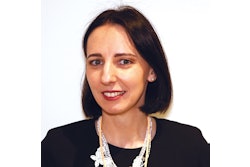
It is early morning in Kyiv, and Pavlo Kovtoniuk has just come home from a bomb shelter. He spent the night there with his wife and child, sheltering from a Russian assault that sent hundreds of drones, cruise missiles, and ballistic missiles toward the city he lives in.
 Pavlo Kovtoniuk was one of the voices heard at the 1st UEMS Congress in Leuven.UEMS
"We cannot afford to wait for better times," he tells them. Kovtoniuk is the co-founder of the Ukrainian Healthcare Center and former Deputy Minister of Health. He is one of several remote voices heard by the Congress (27-30 May 2026) during a session titled "The future of Ukraine's healthcare: European solidarity and support," chaired by Dr. Clive Kilgallen of Dublin.
Five Ukrainian speakers connected from Kyiv, some by video -- if electricity allows -- one live in the room despite the risks of travel, to describe a healthcare system fighting two wars at once: the military conflict that has now lasted twelve years, dating to 2014, and a slower-burning crisis of underfunding, fragmentation, and political inertia that predates it.
It was underfunding and political inertia that set the stage for this session. The proposals on the table were concrete: end the war, secure real political will from state leaders, move to a society-administrative model of management, and critically, shift healthcare financing to a budget-and-insurance model. These were the suggestions of Dr. Oleh Musii, former Minister of Health and now president of the Ukrainian Medical Association, who has co-authored 185 pieces of health legislation over the course of his career.
Musii also diagnosed several reasons for the crisis, among them a lack of systematic state policy, "pseudo-reform lasting eight years," destruction and closure of medical facilities as a consequence of war, and a near-total absence of professional self-governance for doctors, nurses, and pharmacists. The private healthcare sector, he noted, remains capped at a maximum of 5%, while state health spending currently sits around 3% of GDP, against a reform target of a minimum of 7%.
"Early warning for Europe"
 "We cannot afford to wait for better times. The normality is not something to come back on its own. It's something we have to create ourselves," said Pavlo Kovtoniuk, co-founder of the Ukrainian Healthcare Center and former Deputy Minister of Health.UEMS
Anton Volosovets, MD, PhD, head of emergency medicine at Shupyk National Healthcare University, argued in a similar vein: Ukraine's wartime experience in emergency care and mass-casualty response is now a body of expertise Europe needs. The lessons learned, he said, could help prepare European health systems for future challenges.
Child health in Ukraine a European responsibility
One group especially affected are children. As Professor Marina Mamenko, MD, DMedSc, pointed out, she has spent four years documenting what war does to children's health. Citing UNICEF figures from February 2026, she reported that 2.59 million Ukrainian children remain displaced, 791,000 within Ukraine and 1.8 million abroad as refugees. Children are growing up without a sense of safety, as Marina Mamenko showed in her presentation.UEMS
A slide from the "Children of War" portal, covering 24 February 2022 to 26 May 2026, recorded 705 children dead, 2,530 wounded, 2,317 missing, and 20,570 deported or forcibly displaced. Also Ukraine registered fewer than 170,000 births in 2025, compared with roughly 274,000 before the full-scale invasion, a drop close to 38%.
Despite all this, Mamenko emphasized what had continued: medical education, professional congresses, and training programs never stopped. Ukraine introduced HPV vaccination into its national immunization schedule this year, while rebuilding cold-chain logistics around routine blackouts.
Child health in Ukraine, she stressed, is no longer only a Ukrainian issue, but a European responsibility as well, because millions of these children are growing up inside the EU, and their long-term health and development needs will shape European health systems for decades to come. "Ukraine has become resilient," she said, "but resiliency should never mean isolation."
A case of digital health infrastructure
Dr. Olena Lukashevych, public health expert and former director of Kyiv City Public Health, laid out a direct comparison: the European Health Data Space mandates cross-border data access and interoperable patient records by 2030. Ukraine, she said, has already built something close to that, at national scale, during active war.
Lukashevych addressed the Congress on the city's official Kyiv Day, wearing a chestnut-flower motif, the city's symbol, while bracing herself for another round of shelling.
The figures she presented were striking: roughly 35 million registered users in Ukraine's national e-health system, more than 3.3 billion digital medical records, over 80 million e-prescriptions, and more than 590 million e-referrals.
While Europe discusses AI legislation and data space implementation, Ukraine is already running interoperable digital health infrastructure under sustained cyberattack and blackout conditions, and has, by necessity, already solved some of the problems the rest of Europe is still scheduling.