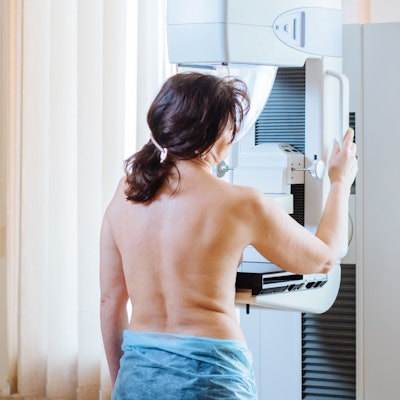
To mark Breast Cancer Awareness Month ("Pink October"), French radiologists with IMEF (Imagerie Médicale de l’Est Francilien) have expressed concern that the participation rate in breast cancer screening has plateaued over recent years.
According to the group, 80% of screening exams are currently conducted by private radiologists and national coverage is only just over 50%.
"Despite their efforts and those of the various stakeholders, the participation rate in breast cancer screening has plateaued for several years between 49 and 53% depending on the region (50.6% national average in 2021)," said radiologist and IMEF manager Dr. Ruxandra Cosson in a news release.
The release highlighted several initiatives of the IMEF group (part of the VIDI network) to increase the rate of breast cancer screening, including completely re-equipping its Livry-Gargan site with the latest generation of imaging equipment.









![Overview of the study design. (A) The fully automated deep learning framework was developed to estimate body composition (BC) (defined as subcutaneous adipose tissue [SAT] in liters; visceral adipose tissue [VAT] in liters; skeletal muscle [SM] in liters; SM fat fraction [SMFF] as a percentage; and intramuscular adipose tissue [IMAT] in deciliters) from MRI. The fully automated framework comprised one model (model 1) to quantify different BC measures (SAT, VAT, SM, SMFF, and IMAT) as three-dimensional (3D) measures from whole-body MRI scans. The second model (model 2) was trained to identify standardized anatomic landmarks along the craniocaudal body axis (z coordinate field), which allowed for subdividing the whole-body measures into different subregions typically examined on clinical routine MRI scans (chest, abdomen, and pelvis). (B) BC was quantified from whole-body MRI in over 66,000 individuals from two large population-based cohort studies, the UK Biobank (UKB) (36,317 individuals) and the German National Cohort (NAKO) (30,291 individuals). Bar graphs show age distribution by sex and cohort. BMI = body mass index. (C) After the performance assessment of the fully automated framework, the change in BC measures, distributions, and profiles across age decades were investigated. Age-, sex-, and height-adjusted body composition reference curves were calculated and made publicly available in a web-based z-score calculator (https://circ-ml.github.io).](https://img.auntminnieeurope.com/mindful/smg/workspaces/default/uploads/2026/05/body-comp.XgAjTfPj1W.jpg?auto=format%2Ccompress&fit=crop&h=112&q=70&w=112)


