Dear AuntMinnieEurope Member,
A leading musculoskeletal radiologist from Kyiv has recently described how she fled Ukraine and is living in Berlin, where she is campaigning for refugee radiologists' ability to work in their host countries.
Although many Ukrainian specialists would like to work as doctors to give back to their host nations, their diplomas aren't currently accepted in the European Union. In a riveting presentation at the annual meeting of the European Society of Musculoskeletal Radiology, Dr. Nataliia Nehria, medical director of MRT Plus in Kyiv, shared her experience in the aftermath of the Russian invasion and called for a simpler and more flexible procedure for validation of Ukrainian diplomas. Our coverage of her talk was the most highly viewed article of the week.
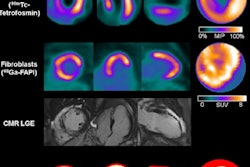
In other news, a group from Hannover Medical School in Germany received the highly coveted Image of the Year award at this week's Society of Nuclear Medicine and Molecular Imaging (SNMMI) meeting in Vancouver, Canada. The honor was bestowed for PET imaging that reveals poor outcomes in patients after a heart attack.
Using a gallium-68-labeled (Ga-68) radiotracer designed to bind to fibroblast cells (Ga-68 FAPI-46), the team found that the fibroblast-activation protein inhibitor (FAPI)-PET signal in injured heart muscle predicted heart dysfunction in patients more than four months later. Get the whole story in the Molecular Imaging Community.
Contrast-enhanced MRI is more sensitive for detecting breast cancer than contrast-enhanced mammography, but it is also less specific, a team of researchers from Austria recently reported. The clinical relevance of these diagnostic performance differences is still unclear, however. Find out more by visiting the Women's Imaging Community.
A French expert has found that an Meanwhile, a presentation at the recent Society for Imaging Informatics in Medicine (SIIM) meeting shared how cloud-based image exchange could finally eliminate the use of CDs.