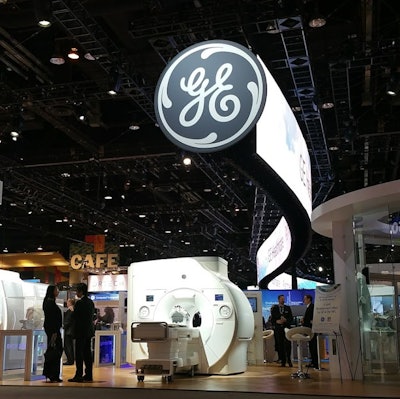
GE Healthcare on July 18 debuted a film about three women's healthcare providers from India, Kenya, and Indonesia, documenting how they are overcoming challenges to bring better care to their communities.
The documentary, titled "Heroines of Health," was created by Emmy Award-winning filmmaker Lisa Russell.
The three women profiled in the film are as follows:
- Mercy Owuor, a community health expert at Lwala Community Alliance in Kenya. She leads a team of rural health workers as they help some 1 million people in western Kenya access healthcare. Her goal is for every child to reach his or her fifth birthday.
- Dr. Sharmila Anand, who founded Santosh Education and Healthcare (SEHPL) in India. SEHPL teaches skills to students who want a career in healthcare, such as becoming an x-ray or anesthesia technician.
- Mrs. Rohani, a volunteer midwife's assistant from a mountain village in South Sulawesi, Indonesia. Her day includes helping expectant mothers travel to the nearest community health center. The journey often takes more than one hour by foot.
The documentary was sponsored by GE's Sustainable Healthcare Solutions division, which the company established in 2015. The business partners with governments and nongovernmental organizations to strengthen healthcare systems and improve the affordability and accessibility of quality healthcare in India, Africa, and Southeast Asia.






![Overview of the study design. (A) The fully automated deep learning framework was developed to estimate body composition (BC) (defined as subcutaneous adipose tissue [SAT] in liters; visceral adipose tissue [VAT] in liters; skeletal muscle [SM] in liters; SM fat fraction [SMFF] as a percentage; and intramuscular adipose tissue [IMAT] in deciliters) from MRI. The fully automated framework comprised one model (model 1) to quantify different BC measures (SAT, VAT, SM, SMFF, and IMAT) as three-dimensional (3D) measures from whole-body MRI scans. The second model (model 2) was trained to identify standardized anatomic landmarks along the craniocaudal body axis (z coordinate field), which allowed for subdividing the whole-body measures into different subregions typically examined on clinical routine MRI scans (chest, abdomen, and pelvis). (B) BC was quantified from whole-body MRI in over 66,000 individuals from two large population-based cohort studies, the UK Biobank (UKB) (36,317 individuals) and the German National Cohort (NAKO) (30,291 individuals). Bar graphs show age distribution by sex and cohort. BMI = body mass index. (C) After the performance assessment of the fully automated framework, the change in BC measures, distributions, and profiles across age decades were investigated. Age-, sex-, and height-adjusted body composition reference curves were calculated and made publicly available in a web-based z-score calculator (https://circ-ml.github.io).](https://img.auntminnieeurope.com/mindful/smg/workspaces/default/uploads/2026/05/body-comp.XgAjTfPj1W.jpg?auto=format%2Ccompress&fit=crop&h=112&q=70&w=112)


