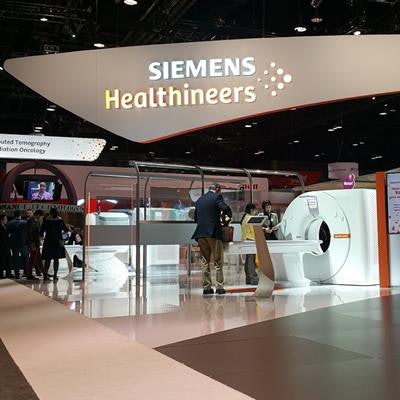
German industrial conglomerate Siemens reported financial results for the second quarter (end-March 31) and also gave the financial community a peek at its thinking behind listing its Siemens Healthineers unit as an independent company later this year.
For the period, Siemens Healthineers posted revenues of $3.78 billion (3.441 billion euros), up 4% on an actual basis and up 2% after currency adjustment from revenues of $3.64 billion (3.319 billion euros) in the corresponding quarter of 2016. The group reported a profit of $645 million (588 million euros), up 6% on an actual basis from a profit of $609 million (555 million euros) in fiscal 2016.
The group's profit margin expanded to 17.1%, compared with 16.7% in the corresponding quarter of 2016. Siemens Healthineers reported the highest profit among Siemens' industrial businesses, although the group's profits fell short of analysts' estimates.
Siemens said revenue increased in nearly all of its segments during the period, particularly from its activities in diagnostic imaging. On a regional basis, growth mainly came from Asia and Australia.
In other news, Siemens executives provided the investment community with additional guidance on the future of Siemens Healthineers, which it intends to spin off as an independent business.
Previously, Siemens had been raising the possibility of an initial public stock offering for the group, but on a conference call with investment analysts on May 4 the executives said that other possibilities could include spinning off the business to existing shareholders or merging the division with an existing company that's already publicly listed, according to an article from Reuters.
Siemens has taken each of the three routes in the past with businesses it has spun off. When asked about the possibilities, Siemens Chief Financial Officer Ralf Thomas said the company was considering "two or three options" for a listing, Reuters noted.