VIENNA - The 2006 European Congress of Radiology (ECR) ended Tuesday with the installation of an Austrian radiologist to lead next year's proceedings, which will also highlight the imaging expertise of China and the Czech Republic.
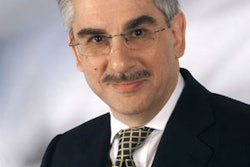
Outgoing ECR president Prof. Dr. Andy Adam from the U.K. welcomed Prof. Dr. Christian Herold to lead the 2007 congress. Herold is a professor of radiology and director of diagnosic radiology at the University of Vienna.
As if the congress could be otherwise, Herold promised a "Viennese ambience" at ECR 2007 that will encompass traditional and modern aspects of Austrian culture without "dominating the show," he said. "The educational and scientific program of ECR 2007 will be rich, attractive, and hopefully entertaining."
The March meeting will stage categorical courses on multidetector-row CT, cancer staging, and signs in imaging, featuring leading experts and interactive teaching methods. The foundation course will focus on cardiac imaging, and minicourses on molecular imaging and women's imaging "will be the new kids on the block in terms of program features," Herold said.
 |
| At the March 7 closing ceremony, ECR 2006 president Prof. Dr. Andy Adam transfers the presidential medallion to Prof. Dr. Christian Herold. |
In addition, a series of new horizons sessions, state-of-the-art sessions, and special-focus sessions will complement the educational program. Evidence-based radiology will not be featured in a separate session. A new initiative on e-learning "will integrate the most modern learning and teaching principles into the meeting," he said.
Next year's ECR Meets countries will be China and the Czech Republic, whose delegations will present special educational and cultural programs. The Czech Republic was a "natural choice" as both a neighbor of Austria and a country that shares a common history, as well as political, professional, and cultural links.
"The invitation of China represents an important step in the further development of strong ties between ECR and Asian countries," Herold said.
 |
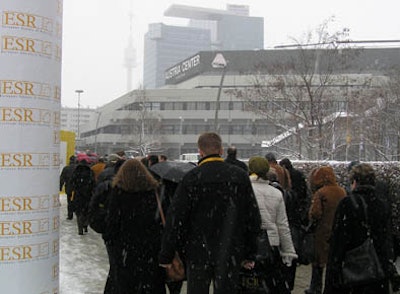
| ECR attendees trudge through the snow toward the Vienna International Center on Sunday, March 5. |
ECR 2007 will be the second congress to be held under the auspices of the European Society of Radiology (ESR). The new society will serve as a strong basis "for the further maturation, growth, increasing power, and influence of European radiology," he said. "We will also use the upcoming ECR to launch an ESR/ECR public awareness campaign, in order to bring radiology to the minds and hearts of all people, patients, officials, and politicians in Austria."
ECR will be held once again at the Vienna International Center, from March 9-13, 2007.