
Bayer and U.K.-based artificial intelligence (AI) software developer Huma are joining forces to develop AI technology to distinguish different forms of non-small-cell lung cancer (NSCLC) on CT exams.
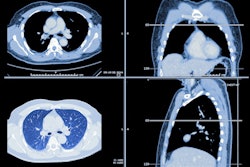
Making use of Huma's machine-learning experience and Bayer's oncology and medical imaging capabilities, the companies plan to utilize machine-learning technology to spot correlations in molecular and imaging assessments -- such as ground-glass opacities -- that can differentiate types of lung cancers. They will then train and test models to provide accurate diagnoses.
The goal is to quickly identify the patients with certain types of NSCLC who can benefit the most from tailored treatments, according to the firms. Their collaboration will begin immediately.
Bayer's Leaps by Bayer investment arm has been both a series B and series C investor in Huma.









![A normal mammogram confirmed by three-year radiologic follow-up illustrates reader-marked regions of interest (ROIs) during (A) unaided (round 1) and (B) artificial intelligence (AI)–assisted (round 2) reading. Each colored dot represents an ROI for recall by a human reader. Readers could mark more than one ROI per case, represented by multiple dots of the same color. During AI-assisted reading, the AI system displayed three visible prompts: two with suspicion of malignancy scores of 35% (left mediolateral oblique [L MLO] and craniocaudal [L CC]) and one with a suspicion of malignancy score of 10% (right craniocaudal [R CC]), shown as polygonal overlays. Without AI, six of 10 readers (60%) marked a false-positive ROI. With AI assistance, this fell to two of 10 (20%). R MLO = right mediolateral oblique.](https://img.auntminnieeurope.com/mindful/smg/workspaces/default/uploads/2026/07/2026-07-14-radiology-mammogram-ai-auto-bias.H0bYO8QlWs.jpg?auto=format%2Ccompress&fit=crop&h=112&q=70&w=112)


