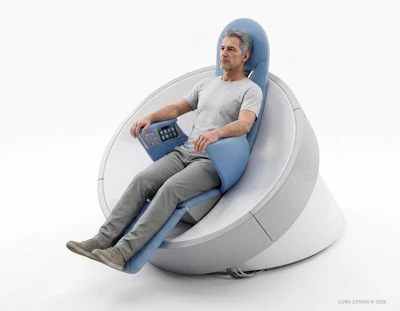
A consortium led by Radboud University Medical Center and Tesla Engineering has secured 25 million euros to develop an open, chair-based MRI scanner for prostate cancer detection.
Patients would sit above a conical magnet built into the chair rather than lie inside a scanner. The design relies on a new type of superconductor that carries more electrical current and allows magnets to be built in shapes other than a tunnel, according to the consortium. The scanner operates at 20 kHz, which is above the range of human hearing, and its magnet is cooled with a cold gas rather than liquid helium.
The device is initially being developed for men with suspected prostate cancer and images only part of the lower body. The goal is for it to operate autonomously without on-site staff, and the technology could later be adapted for breast and brain imaging, said project leader Dennis Klomp, PhD, in a statement from Radboud.
The European Innovative Health Initiative is providing 15 million euros of the funding, with industry partners contributing the remaining 10 million euros. The consortium includes 19 additional partners, among them University Medical Center Utrecht.