Medical imaging, including coronary calcium scoring and AI-powered analysis, is central to Europe's Safe Hearts Plan to prevent cardiovascular disease, the continent's leading cause of death claiming 3.9 million lives annually. The plan emphasizes early detection and personalized care by integrating imaging throughout the patient journey, from risk assessment before symptoms appear to treatment monitoring and outcome evaluation.
- Cardiovascular disease kills over 3.9 million Europeans annually and costs the EU an estimated €282 billion yearly
- Coronary artery calcium scoring (CACS) using low-dose CT can identify elevated cardiovascular risk long before symptoms develop
- Medical imaging supports all three pillars of the Safe Hearts Plan: prevention, early detection, and personalized care
- AI is transforming imaging from visual interpretation to quantitative biomarkers that enable better risk prediction and personalized treatment
- Chest CT scans for lung cancer screening already capture coronary calcification, providing cardiovascular risk assessment without additional imaging costs
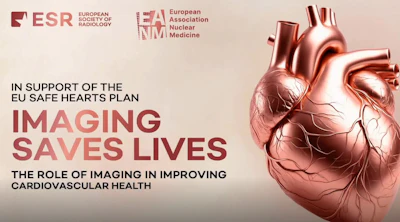
Medical imaging will play a pivotal role in implementing the European Commission's Safe Hearts Plan, speakers said during a joint ESR/EANM event at the European Parliament in Brussels on July 2. The proposal aims to strengthen cardiovascular prevention, early detection, and personalized care across Europe.
Cardiovascular disease remains the leading cause of death in Europe, claiming more than 3.9 million lives each year and costing the EU an estimated €282 billion annually, according to the ESR/European Society of Cardiovascular Radiology (ESCR) policy briefing presented during the meeting.
Europe must move beyond treating cardiovascular disease only after clinical events occur, said MEP Romana Jerković, vice-chair of the European Parliament's Committee on Public Health (SANT), chair of the MEP Group on Cardiovascular Health, and rapporteur on Parliament's cardiovascular health report.
"Medical imaging becomes indispensable," she said, describing radiology and nuclear medicine as fundamental throughout the patient journey, from detecting disease before symptoms appear to guiding treatment decisions and monitoring outcomes.
Policy paper calls for broader use of coronary calcium scoring and AI.
"We have to be preventive and use our means cleverly," said ESR President Prof. Mathias Prokop, who argued that imaging supports each of the Safe Hearts Plan's three pillars while helping healthcare systems make better use of existing resources.
Prokop noted that chest CT scans performed for lung cancer screening already capture coronary artery calcification, creating an opportunity to assess cardiovascular risk without additional imaging. Better use of information already available from routine examinations, he said, could improve prevention while avoiding unnecessary costs.
A central recommendation of the new ESR/ESCR policy paper is broader adoption of coronary artery calcium scoring (CACS). The societies are calling for the low-dose CT technique to be integrated into national cardiovascular health checks and existing screening programs, saying it can identify individuals at elevated cardiovascular risk long before symptoms develop.
EANM President Prof. Paola Anna Erba said cardiovascular imaging is evolving from producing pictures to generating quantitative biomarkers, allowing clinicians to better predict risk and tailor treatment to individual patients.
Artificial intelligence was also featured prominently in the discussions. The ESR/ESCR policy paper envisions AI supporting every stage of the imaging workflow, from scan acquisition and image interpretation to biomarker quantification and reporting, and calls for greater investment in interoperable health data infrastructure, workforce training, and harmonized reporting to accelerate implementation across Europe.
For speakers, the challenge now is implementation. Delivering the Safe Hearts Plan, they said, will require imaging to be integrated across the cardiovascular care pathway, backed by closer collaboration between specialties, investment in digital infrastructure, and wider adoption of advanced imaging technologies.