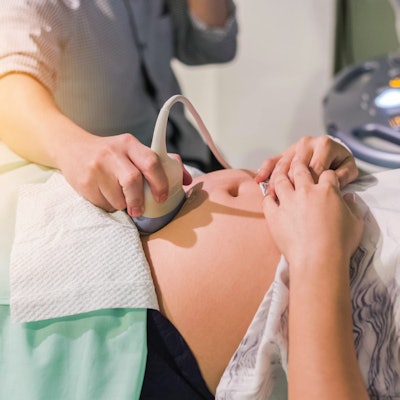
A King's College London sonographer has started a study under the auspices of the U.K. Society of Radiographers (SoR) Industry Partnership Scheme (CoRIPS) that will explore women's perceptions and experiences with ultrasound during pregnancy.
Sonographer Jackie Matthew will explore attitudes toward prenatal ultrasound screening held by pregnant women, the public, and healthcare providers. She will particularly focus on including minority group participants in the study.
"Ultrasound and MR imaging are commonly used during pregnancy to diagnose health conditions in the baby and mother," the college said in a statement. "However, many pregnancy-related studies do not include enough women from ethnically diverse backgrounds, which increases the risk of inaccurate results. This may mean that the results are not as valid for some women."
The study is called "Rep All Women." Matthew will work with Best Beginnings, a new parent support organization in London, as well as other women's health networks, the SoR said.








![Overview of the study design. (A) The fully automated deep learning framework was developed to estimate body composition (BC) (defined as subcutaneous adipose tissue [SAT] in liters; visceral adipose tissue [VAT] in liters; skeletal muscle [SM] in liters; SM fat fraction [SMFF] as a percentage; and intramuscular adipose tissue [IMAT] in deciliters) from MRI. The fully automated framework comprised one model (model 1) to quantify different BC measures (SAT, VAT, SM, SMFF, and IMAT) as three-dimensional (3D) measures from whole-body MRI scans. The second model (model 2) was trained to identify standardized anatomic landmarks along the craniocaudal body axis (z coordinate field), which allowed for subdividing the whole-body measures into different subregions typically examined on clinical routine MRI scans (chest, abdomen, and pelvis). (B) BC was quantified from whole-body MRI in over 66,000 individuals from two large population-based cohort studies, the UK Biobank (UKB) (36,317 individuals) and the German National Cohort (NAKO) (30,291 individuals). Bar graphs show age distribution by sex and cohort. BMI = body mass index. (C) After the performance assessment of the fully automated framework, the change in BC measures, distributions, and profiles across age decades were investigated. Age-, sex-, and height-adjusted body composition reference curves were calculated and made publicly available in a web-based z-score calculator (https://circ-ml.github.io).](https://img.auntminnieeurope.com/mindful/smg/workspaces/default/uploads/2026/05/body-comp.XgAjTfPj1W.jpg?auto=format%2Ccompress&fit=crop&h=112&q=70&w=112)
