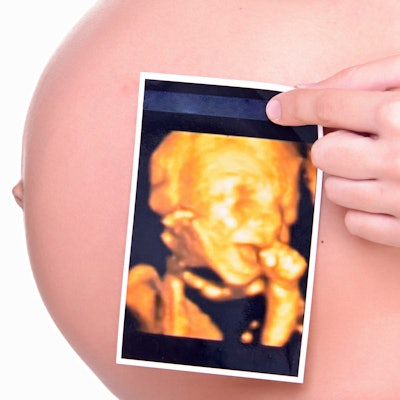
The growing trend of members of the public performing their own pregnancy ultrasound scans at home has prompted the British Medical Ultrasound Society (BMUS) and the U.K. Society and College of Radiographers (SCoR) to issue a statement emphasizing the need for ultrasound equipment to be used only by properly trained professionals.
It's natural and understandable that expectant parents would want to see their unborn baby, but there are strong concerns that the use of ultrasound in inexperienced and untrained hands could provide false reassurance of fetal wellbeing or even cause harm if exposure is prolonged, according to the societies.
"Both the SCoR and BMUS recommend that ultrasound examinations are only performed by appropriate professionals, who can interpret the ultrasound images accurately and use the equipment safely, to reduce any potential harm to the baby or anxiety for parents," they wrote.
The full position statement can be found on the SCoR's website.








![Overview of the study design. (A) The fully automated deep learning framework was developed to estimate body composition (BC) (defined as subcutaneous adipose tissue [SAT] in liters; visceral adipose tissue [VAT] in liters; skeletal muscle [SM] in liters; SM fat fraction [SMFF] as a percentage; and intramuscular adipose tissue [IMAT] in deciliters) from MRI. The fully automated framework comprised one model (model 1) to quantify different BC measures (SAT, VAT, SM, SMFF, and IMAT) as three-dimensional (3D) measures from whole-body MRI scans. The second model (model 2) was trained to identify standardized anatomic landmarks along the craniocaudal body axis (z coordinate field), which allowed for subdividing the whole-body measures into different subregions typically examined on clinical routine MRI scans (chest, abdomen, and pelvis). (B) BC was quantified from whole-body MRI in over 66,000 individuals from two large population-based cohort studies, the UK Biobank (UKB) (36,317 individuals) and the German National Cohort (NAKO) (30,291 individuals). Bar graphs show age distribution by sex and cohort. BMI = body mass index. (C) After the performance assessment of the fully automated framework, the change in BC measures, distributions, and profiles across age decades were investigated. Age-, sex-, and height-adjusted body composition reference curves were calculated and made publicly available in a web-based z-score calculator (https://circ-ml.github.io).](https://img.auntminnieeurope.com/mindful/smg/workspaces/default/uploads/2026/05/body-comp.XgAjTfPj1W.jpg?auto=format%2Ccompress&fit=crop&h=112&q=70&w=112)


