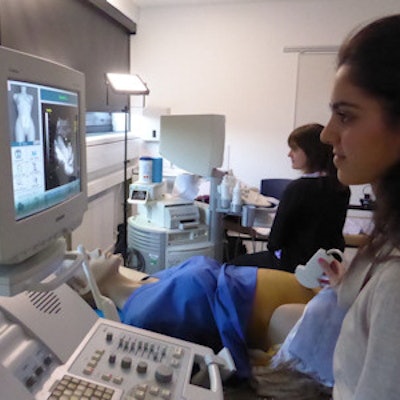
To continue working safely as the pandemic progresses, sonographers must take into account their local context and setting, according to Gill Harrison, professional officer for ultrasound at the U.K. Society and College of Radiographers (SCoR). National guidance can help, but it's important for departments to have risk assessments that consider their working environment, individual staff needs, and patient types, she noted in an article on the SCoR website.
It goes without saying, but a policy must be in place that all staff adhere to and should include potential situations as well, such as what if a patient cannot wear a mask? Or what if they can but they refuse? In addition, any and all policy changes should be publicized, Harrison added.
Other considerations for this time include pondering alternative ways of working. For instance, can vulnerable patients be seen in a different room than other patients? And if this occurred, would it give sonographers enough workload variety that they don't increase their risk of work-related musculoskeletal disorders? Another alternative to consider is can Perspex screens be used in waiting areas or scan rooms?
"Staff support will be essential as sonographers continue to work under extremely difficult circumstances," Harrison wrote. "Additional time is required for examinations to enable cleaning to be undertaken. Good leadership, inter-professional team working, and communication are crucial to provide effective, safe, working environments for patients, staff, and the wider community."
To read Harrison's viewpoint in full, go here.







![Overview of the study design. (A) The fully automated deep learning framework was developed to estimate body composition (BC) (defined as subcutaneous adipose tissue [SAT] in liters; visceral adipose tissue [VAT] in liters; skeletal muscle [SM] in liters; SM fat fraction [SMFF] as a percentage; and intramuscular adipose tissue [IMAT] in deciliters) from MRI. The fully automated framework comprised one model (model 1) to quantify different BC measures (SAT, VAT, SM, SMFF, and IMAT) as three-dimensional (3D) measures from whole-body MRI scans. The second model (model 2) was trained to identify standardized anatomic landmarks along the craniocaudal body axis (z coordinate field), which allowed for subdividing the whole-body measures into different subregions typically examined on clinical routine MRI scans (chest, abdomen, and pelvis). (B) BC was quantified from whole-body MRI in over 66,000 individuals from two large population-based cohort studies, the UK Biobank (UKB) (36,317 individuals) and the German National Cohort (NAKO) (30,291 individuals). Bar graphs show age distribution by sex and cohort. BMI = body mass index. (C) After the performance assessment of the fully automated framework, the change in BC measures, distributions, and profiles across age decades were investigated. Age-, sex-, and height-adjusted body composition reference curves were calculated and made publicly available in a web-based z-score calculator (https://circ-ml.github.io).](https://img.auntminnieeurope.com/mindful/smg/workspaces/default/uploads/2026/05/body-comp.XgAjTfPj1W.jpg?auto=format%2Ccompress&fit=crop&h=112&q=70&w=112)


