Removable dentures got stuck in a 72-year-old man's throat during surgery to remove a benign lump. Doctors didn't find the false teeth until eight days later when the patient complained of pain, bleeding, and swallowing difficulties.
U.K.-based ear, nose, and throat (ENT) specialist Dr. Harriet Cunniffe wrote about the experience and key learnings in the journal BMJ Case Reports (12 August 2019). She cautioned that dentures should be taken out before a patient undergoes general anesthesia.
“There are no set guidelines on how dentures should be managed during general anesthesia.”
"There are no set guidelines on how dentures should be managed during general anesthesia, but it is known that leaving dentures in during bag-mask ventilation allows for a better seal during induction, and, therefore, many hospitals allow dentures to be removed immediately before intubation, as long as this is clearly documented," she wrote.
The patient in the report was an active 72-year-old retired electrician who had a benign lump extracted from his abdominal wall. Six days later, he presented to James Paget University Hospital in Yarmouth, U.K., complaining of odynophagia, dysphagia, and hemoptysis.
Doctors at the emergency department attributed the symptoms to a respiratory infection and side effects from anesthesia during the surgery. They prescribed him mouthwash, antibiotics, and steroids and sent him home.
Two days later, the patient returned to the hospital, stating he couldn't swallow the prescribed medication. This time, the hospital staff suspected pneumonia. They admitted him to the hospital and referred him to the ENT department.
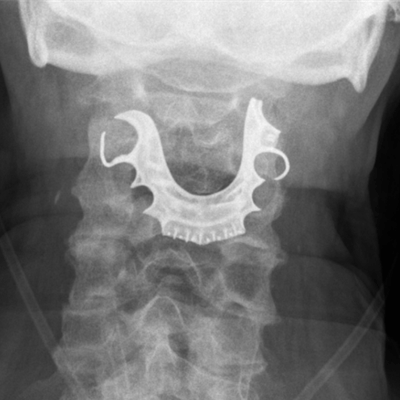
An ENT exam revealed a "metallic semicircular object overlying the vocal cords and completely obstructing their view." When the doctor told this to the patient, he revealed that he had lost his partial dentures during his surgery stay eight days earlier.
 Anteroposterior neck radiograph of the 72-year-old man. Image courtesy of BMJ Case Reports 2019.
The patient received emergency surgery to remove the dentures from his throat. He was discharged six days later but returned after another case of bleeding. The discharge and readmission cycle occurred several more times until doctors realized he had a torn artery where the dentures had been.
Once the doctors addressed the torn artery, the man began to heal. A week after his final surgery, the tissue was healing well, Cunniffe noted. Six weeks later, he needed no further emergency care and his blood count stabilized.
"This case highlights a number of important learning points," she wrote. "The first is to always listen to your patient. ... However, with easy access to imaging and laboratory tests, we are all sometimes guilty of relying on these investigations."