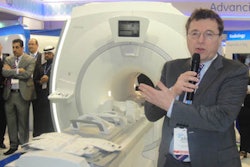
GE Healthcare will highlight its new Revolution CT scanner and Centricity 360 image-sharing software at this week's Arab Health 2014 meeting in Dubai, United Arab Emirates.
First introduced at RSNA 2013, Revolution is GE's new CT platform that combines radiation dose reduction technologies with broader anatomic coverage. The system features 16 cm of coverage per rotation, compared with 4 cm on older GE CT scanners. Revolution is pending 510(k) clearance from the U.S. Food and Drug Administration (FDA).
Also launched at RSNA 2013, Centricity 360 is GE's new cloud-based software for the exchange of medical images. Designed to improve collaboration between physicians and patients, Centricity 360 enables caregivers to exchange images and join private communities to collaborate on diagnosis and treatment discussions in near real-time, according to the vendor.
Because all Centricity 360 applications and collaboration tools are provided via a cloud services platform, no upfront investment is required from clinical users, patients, or integrated delivery networks.
Another notable GE highlight at Arab Health 2014 will be the company's VolumeRad chest tomosynthesis system for advanced radiography studies. VolumeRad is designed for the detection of lung nodules and to provide physicians with multiple high-resolution slice images of the anatomy of interest, including the chest, abdomen, extremities, and spine.
Maher Abouzeid, president and CEO of GE Healthcare for the Middle East and Pakistan, noted that healthcare expenditures in the Gulf Cooperation Council (GCC) region have grown 7.9% per year over the past 10 years, and total healthcare expenditure in the area is expected to be $79.2 billion in 2015.