Only three European Training Requirements (ETRs) are fully implemented anywhere on the continent. Three out of more than 70 have been adopted across all medical specialties. Radiology is one of them.
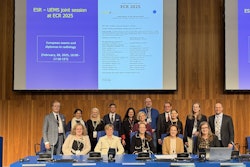
At ECR 2026, "Harmonia: The Power of Collaboration" traced how that happened: years of sustained collaboration between the European Society of Radiology (ESR) and the European Union of Medical Specialists (UEMS).
The session gathered leaders from UEMS, the European Board of Radiology (EBR), and the Accreditation Council in Imaging (ACI) to map where the system stands and where it needs to be improved.
Collaboration by design
Dr. Paolo Ricci, PhD, of Sapienza University of Rome in Rome, Italy, and vice-president of the UEMS Section of Radiology presented the UEMS case. Founded in 1958, UEMS represents more than 1.7 million specialist doctors across 42 countries to promote free movement of doctors in the medical profession through harmonization of specialist training.
European Training Requirements complement national training decisions rather than overriding them, developed through the widest possible consultation with national authorities and scientific societies.
Ricci traced this work back to the first doctors' directive from 1975 through to the current automatic qualification recognition framework in 2005. Free movement was always conditional on mutual recognition. And mutual recognition requires a shared standard. The first UEMS Congress, Leuven, late May 2026, will include dedicated sessions on ETR implementation and a new pathway for neuroradiology. A new online journal, the European Medical Specialist Review, has just been registered.
Radiology leads Europe
Dr. Miraude Adriaensen, PhD, of Zuyderland Medical Center in Heerlen, the Netherlands; Dr. Anagha Parkar, of Haraldsplass Deaconess Hospital in Bergen, Norway; and Mitja Rupreht, MD, of University Medical Center Maribor in Maribor, Slovenia, presented the Accreditation Council in Imaging. The 2025 numbers: 329 accredited events in radiology, up 25% on 2024, reaching more than 50,000 attendees across 40 countries. Radiology accredited more events than any other medical specialty in Europe in 2025.
A November 2024 reform merged the ACI's scientific director and reviewing committee chair roles. New criteria introduced in 2023 include microlearning. Parkar's practical note for organizers: Build a deadline calendar and stick to it. The application process will not wait.
The diploma, and mindset behind it
Dr. Laura Oleaga Zufiria, of Hospital Clínic of Barcelona in Barcelona, Spain, opened the section on the European Diploma in Radiology (EDiR) with a call to ambassadorship: Holders must become advocates for the diploma. There are more than 5,500 diplomates since 2011 and over 1,000 applicants annually. Equivalent to national boards in Poland, Romania, the Netherlands, and the written part of Croatia's exam, the diploma is also recognized in France, Belgium, Italy, India, and Pakistan.
Dr. Rosana Santos, of Affidea, Lisbon, Portugal, walked through the three question types, multiple response, short cases, and core cases -- each designed to test reasoning, not recall.
Dr. Barbora Horehledova, of Zuyderland Medical Center in Heerlen, the Netherlands, the EDiR Educational Grant Winner 2025, reframed the whole thing: Treat it as a self-audit of your training, not an exam. Start with the subspecialties you encounter least.
"I approach preparation not as preparation for an exam," she said, "but as an opportunity to become a better radiologist."
ETAP: the audit that changes things
Dr. Jeannette Kraft, of Leeds Teaching Hospitals NHS Trust in Leeds, U.K., introduced the European Training Assessment Programme (ETAP), which is voluntary, fully online, has six steps, and involves no travel. Dr. Colin Cantwell, of St. Vincent's University Hospital in Dublin, Ireland, described the assessor's process: questionnaire, facility video, one-hour online interview with department leadership and residents, and a SWOT (strengths, weaknesses, opportunities, and threats) report two weeks later.
Prof. Dr. Jens Bremerich, of University Hospital Basel in Basel, Switzerland, shared what the process revealed at the first-ever evaluated center. Three gaps surfaced: insufficient research integration, no management training, and excessive on-call load for residents. All three were addressed. One risk was flagged openly: a large share of residents come from Germany.
"It's more of a political topic," Bremerich said. Basel has since been recertified, and applicants now cite the listing as a reason they chose to apply there.
The standard behind the standards
A sharp question surfaced during the Q&A. The European Training Curriculum has not had formal UEMS recertification since 2018, even as it is updated internally within the ESR. A delegate asked directly: at what interval should the ESR be requesting recertification?
Panelists acknowledged the curriculum is being revised. One panelist raised a second concern: that the curriculum may have become too subspecialty-heavy for general training programs.
"I think it's good to have a strong curriculum personally, as something to work towards, as long as the exams are fair for the level," one panelist said.
During the Q&A, a participant argued that the ESR must actively request UEMS recertification of the curriculum. Only three ETRs are fully implemented in Europe, they noted. Radiology is one of them.