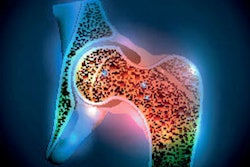
A Vienna company that develops artificial intelligence (AI)-based software for the diagnosis of musculoskeletal (MSK) diseases has won the Best New Radiology Vendor award in the 2021 EuroMinnies.
In a video interview with AuntMinnieEurope.com, CEO and co-founder Dr. Richard Ljuhar of ImageBiopsy Lab explains how his firm can help radiologists in their daily work. He also speaks about how the pandemic has affected the company, market trends for AI software, the COVID-19 restrictions currently in place in Vienna, and his hopes and plans for the future.
If you want to find out more, you can watch a video on YouTube.com with MSK radiologist Dr. Christoph Agten and machine-learning expert Christoph Haarburger. They challenge and review IB Lab HIPPO, one of ImageBiopsyLab's four AI-driven software solutions for automated measurements on radiographs. In the last few minutes of the video, Agten provides a head-to-head comparison of HIPPO versus manual annotations.
Now in its third year, the 2021 EuroMinnies award scheme is an annual event recognizing excellence in radiology. Candidates are nominated by AuntMinnieEurope.com members, with winners selected by an expert panel in two rounds of voting. A full list of winners in the 2021 edition of the EuroMinnies is available on AuntMinnieEurope.com.


![A normal mammogram confirmed by three-year radiologic follow-up illustrates reader-marked regions of interest (ROIs) during (A) unaided (round 1) and (B) artificial intelligence (AI)–assisted (round 2) reading. Each colored dot represents an ROI for recall by a human reader. Readers could mark more than one ROI per case, represented by multiple dots of the same color. During AI-assisted reading, the AI system displayed three visible prompts: two with suspicion of malignancy scores of 35% (left mediolateral oblique [L MLO] and craniocaudal [L CC]) and one with a suspicion of malignancy score of 10% (right craniocaudal [R CC]), shown as polygonal overlays. Without AI, six of 10 readers (60%) marked a false-positive ROI. With AI assistance, this fell to two of 10 (20%). R MLO = right mediolateral oblique.](https://img.auntminnieeurope.com/mindful/smg/workspaces/default/uploads/2026/07/2026-07-14-radiology-mammogram-ai-auto-bias.H0bYO8QlWs.jpg?auto=format%2Ccompress&fit=crop&h=100&q=70&w=100)


![A normal mammogram confirmed by three-year radiologic follow-up illustrates reader-marked regions of interest (ROIs) during (A) unaided (round 1) and (B) artificial intelligence (AI)–assisted (round 2) reading. Each colored dot represents an ROI for recall by a human reader. Readers could mark more than one ROI per case, represented by multiple dots of the same color. During AI-assisted reading, the AI system displayed three visible prompts: two with suspicion of malignancy scores of 35% (left mediolateral oblique [L MLO] and craniocaudal [L CC]) and one with a suspicion of malignancy score of 10% (right craniocaudal [R CC]), shown as polygonal overlays. Without AI, six of 10 readers (60%) marked a false-positive ROI. With AI assistance, this fell to two of 10 (20%). R MLO = right mediolateral oblique.](https://img.auntminnieeurope.com/mindful/smg/workspaces/default/uploads/2026/07/2026-07-14-radiology-mammogram-ai-auto-bias.H0bYO8QlWs.jpg?auto=format%2Ccompress&fit=crop&h=112&q=70&w=112)