

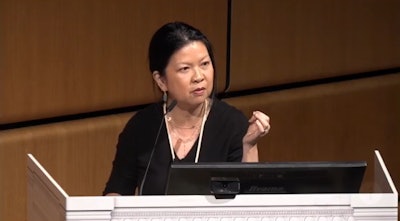
AI will further improve BI-RADS in later editions in measuring breast cancer risk, according to a presentation given on 6 March at ECR 2026.
In her talk, Dr. Linda Moy, from NYU Langone Health in New York City, shared her thoughts on how radiologists should become AI literate as well as the need for more data and audits to validate the latest version of BI-RADS.
“Where we’re going is what I’m calling AI-driven BI-RADS as a future workflow,” Moy said.
 Dr. Linda Moy.
The American College of Radiology (ACR) in late 2025 published its latest edition of BI-RADS, the first such update since 2013. Some additions to this version include new descriptors for elasticity assessment on breast ultrasound, MR imaging for breast implants, and nonmass lesions on ultrasound and digital breast tomosynthesis (DBT), among others. It also includes 900 clinical images that breast radiologists can use as a reference point.
Radiologists continue to explore ways to integrate AI algorithms into clinical workflows, with research suggesting that AI assistance could lead to better patient outcomes.
“We really need help from AI to decrease the number of follow-up exams and benign biopsies,” Moy said.
She added that BI-RADS “has not fully adapted to” complexities in real-world settings for common benign findings and new modalities such as contrast-enhanced mammography (CEM). Prior studies also suggest moderate inter-reader variability for BI-RADS 3 and 4 lesions.
Moy also said the data used to update BI-RADS is largely qualitative and has weak integration across imaging modalities and over time.
“That makes it hard for us to really apply large-scale data capture to help improve this,” Moy said. “The update cycles for BI-RADS lag behind imaging and AI innovation.”
She cited recent studies showing how standalone AI can be on par with radiologists interpreting mammography images and how AI can detect interval cancers missed on initial screening. She also highlighted the MASAI trial, which showed that AI assistance leads to improved cancer detection rates and positive predictive values, and also found that AI led to a 44% workload reduction.
Moy emphasized the importance of AI literacy among radiologists. This includes having radiologists be aware of the advantages and challenges of AI use, so they don’t over-trust AI in breast cancer screening.
Finally, she outlined how shifting from qualitative to quantitative data could help improve BI-RADS by standardizing data points to be machine-readable.
“BI-RADS [currently] underrepresents quantitative and prognostic information that modern imaging can provide,” she said.
She proposed that the future BI-RADS pipeline will include AI-calibrated risk estimates. This includes having AI provide continuous malignancy scores, refine and harmonize lexicon descriptors, and improve cross-modality consistency. This shift in data will help create the machine-readable framework needed for AI to perform, she added.
“I would say that the long-term vision is a computable, adaptive BI-RADS that integrates AI outputs with patient-level risk to support personalized management,” Moy said.
Our full coverage of ECR 2026 can be found here.








![A normal mammogram confirmed by three-year radiologic follow-up illustrates reader-marked regions of interest (ROIs) during (A) unaided (round 1) and (B) artificial intelligence (AI)–assisted (round 2) reading. Each colored dot represents an ROI for recall by a human reader. Readers could mark more than one ROI per case, represented by multiple dots of the same color. During AI-assisted reading, the AI system displayed three visible prompts: two with suspicion of malignancy scores of 35% (left mediolateral oblique [L MLO] and craniocaudal [L CC]) and one with a suspicion of malignancy score of 10% (right craniocaudal [R CC]), shown as polygonal overlays. Without AI, six of 10 readers (60%) marked a false-positive ROI. With AI assistance, this fell to two of 10 (20%). R MLO = right mediolateral oblique.](https://img.auntminnieeurope.com/mindful/smg/workspaces/default/uploads/2026/07/2026-07-14-radiology-mammogram-ai-auto-bias.H0bYO8QlWs.jpg?auto=format%2Ccompress&dpr=2&fit=crop&h=167&q=70&w=250)


