Dear Women's Imaging Insider,
The critics of breast cancer screening are stirring things up again -- this time targeting France. The French health minister has made changes to the breast cancer screening program, and opponents of screening approve. Meanwhile, breast screening advocates are shaking their heads in disbelief. Again. Read more about the controversy.
A major drawback of breast cancer screening is overdiagnosis. However, breast MRI expert Dr. Christiane Kuhl said overdiagnosis is not the main problem with screening mammography. Rather, underdiagnosis is the main issue. Too many women are still dying from the disease and that should be the main concern. Discover what else she had to say, such as whether breast MRI screening is feasible.
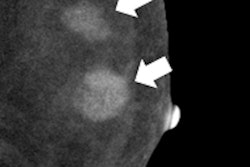
In other mammography news, contrast-enhanced spectral mammography catches an additional 7.7% of lesions in recalled women -- and most of these lesions are malignant, Dutch researchers found. Plus, the low risks of using the tool make it a valuable addition to breast cancer care.
Also in your Women's Imaging Community, French radiologists are set to become TV stars. A new television advertising campaign aired to promote breast cancer screening in tandem with breast cancer awareness month. Did it work? Are the radiologists famous now? Tell us in the Forums.
Are you still double reading digital mammograms? Maybe it's time to end the practice, according to Spanish researchers. Their research suggests double reading wastes time and money without adding much benefit.
Be sure to visit the Women's Imaging Community to read other stories that will interest you. And as always, I enjoy hearing from you, so contact me anytime.



![A normal mammogram confirmed by three-year radiologic follow-up illustrates reader-marked regions of interest (ROIs) during (A) unaided (round 1) and (B) artificial intelligence (AI)–assisted (round 2) reading. Each colored dot represents an ROI for recall by a human reader. Readers could mark more than one ROI per case, represented by multiple dots of the same color. During AI-assisted reading, the AI system displayed three visible prompts: two with suspicion of malignancy scores of 35% (left mediolateral oblique [L MLO] and craniocaudal [L CC]) and one with a suspicion of malignancy score of 10% (right craniocaudal [R CC]), shown as polygonal overlays. Without AI, six of 10 readers (60%) marked a false-positive ROI. With AI assistance, this fell to two of 10 (20%). R MLO = right mediolateral oblique.](https://img.auntminnieeurope.com/mindful/smg/workspaces/default/uploads/2026/07/2026-07-14-radiology-mammogram-ai-auto-bias.H0bYO8QlWs.jpg?auto=format%2Ccompress&fit=crop&h=100&q=70&w=100)


![A normal mammogram confirmed by three-year radiologic follow-up illustrates reader-marked regions of interest (ROIs) during (A) unaided (round 1) and (B) artificial intelligence (AI)–assisted (round 2) reading. Each colored dot represents an ROI for recall by a human reader. Readers could mark more than one ROI per case, represented by multiple dots of the same color. During AI-assisted reading, the AI system displayed three visible prompts: two with suspicion of malignancy scores of 35% (left mediolateral oblique [L MLO] and craniocaudal [L CC]) and one with a suspicion of malignancy score of 10% (right craniocaudal [R CC]), shown as polygonal overlays. Without AI, six of 10 readers (60%) marked a false-positive ROI. With AI assistance, this fell to two of 10 (20%). R MLO = right mediolateral oblique.](https://img.auntminnieeurope.com/mindful/smg/workspaces/default/uploads/2026/07/2026-07-14-radiology-mammogram-ai-auto-bias.H0bYO8QlWs.jpg?auto=format%2Ccompress&fit=crop&h=112&q=70&w=112)