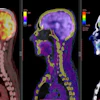
An experimental somatostatin receptor subtype 2 (SST2)-targeting PET tracer labeled with copper-61 (C-61) shows promise over standard-of-care tracers in patients with neuroendocrine tumors, according to a recent study.
In first-in-human data presented at the recent Society of Nuclear Medicine and Molecular Imaging annual meeting, researchers presented evidence comparing Cu-61 NODAGA-LM3 PET and gallium-68 (Ga-68) DOTATOC PET in 22 patients.
"Cu-61 NODAGA-LM3 is a safe, effective SST2 PET tracer with favorable kinetics, biodistribution, and dosimetry, offering logistical and diagnostic advantages over Ga-68 DOTATOC in [neuroendocrine tumors]," reported lead author Guillaume Nicolas, MD, of University Hospital Basel in Switzerland, and colleagues.
Neuroendocrine tumors (NETs) originate from neuroendocrine cells and are most commonly found in the gastrointestinal tract, pancreas, and lung. Many NETs grow slowly and are asymptomatic, leading to up to 50% being metastatic at diagnosis. Overexpression of SST2 is a characteristic of NETs and presents an important molecular target for the management of these tumors, the authors explained.
In Switzerland, two radiolabeled somatostatin analogues, Ga-68 DOTATOC and Ga-68 DOTATATE, are used for SST PET/CT imaging of well-differentiated neuroendocrine tumors. While these tracers provide high clinical performance and can be locally produced, they face limitations such as high costs, limited production capacity, a short half-life hindering shipment to smaller centers, and high physiological uptake in organs like the liver, which complicates tumor detection, the group noted.
With a half-life of 3.3 hours, cyclotron-produced Cu-61 NODAGA-LM3 could allow delayed imaging and centralized distribution, while its lower positron energy (mean Eβ+ 500 keV) compared to Ga-68 (mean Eβ+ 830) also improves spatial resolution, according to the researchers.
To evaluate the tracer in humans, the investigators enrolled 22 patients with SST2-positive, well-differentiated gastroenteropancreatic or bronchopulmonary NETs. The participants underwent both Cu-61 NODAGA-LM3 PET/CT at one and three hours post-injection Ga-68 DOTATOC PET/CT at one hour post-injection, on the same scanner within four weeks. Composite imaging or biopsy within two to seven months served as the reference standard.
 Maximum intensity projections showing biodistribution of Cu-61 NODAGA-LM3 (146 MBq) in a patient with a metastatic non-functional NET of the pancreas G2 (Ki-67: 5%) with lymph node, hepatic, osseous, and peritoneal as well as ovarian metastases. PET performed a 1-hour, 3-hours, and 18-hours post-injection show high and prolonged tumor uptake and excellent image contrast, with low uptake in the liver, intestinal tract, and other non-target organs.Guillaume Nicolas, MD, and SNMMI
Tumor uptake was slightly higher at both one hour (+8%) and three hours (+13%) post-injection, though neither difference reached significance. Lastly, compared with [⁶⁸Ga]Ga-DOTATOC, tumor-to-background ratios were 63% higher at one hour and 90% higher at three hours, the researchers reported.
“Cu-61 NODAGA-LM3 is a novel SST2-targeting antagonist designed as a PET tracer to overcome limitations of Ga-68 based compounds regarding production, image quality, and logistics,” the group wrote.
The authors indicated that sensitivity and diagnostic accuracy outcomes from the phase I/II trial will be presented in a future report.
For similar stories and updates, check out AuntMinnie’s Radiopharmaceutical Therapy Tracker.