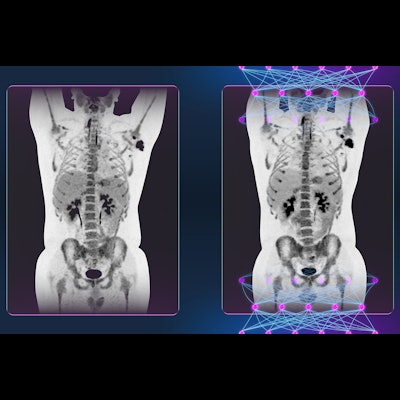
GE Healthcare has launched the Omni PET/CT platform and Omni Legend system at the annual meeting of the European Association of Nuclear Medicine (EANM) in Barcelona, Spain.
The product contains a novel type of digital bismuth germanate (dBGO) detector material with a small crystal size that delivers more than two times the sensitivity of prior digital scanners, enabling faster total scan times and improved small lesion detectability, according to the vendor.
GE states that Omni Legend 32 cm increases small lesion detectability by 16% on average and up to 20%, as compared with the Discovery MI 25 cm with matched scan time/injected dose, as demonstrated in phantom testing using a model observer with 4 mm lesions.
The system uses an artificial intelligence (AI)-based Auto Positioning Camera and Precision DL, a deep-learning image processing software, and offers the capability to scan beyond FDG with short-life tracers for cardiac and neuroimaging that can enable different procedures such as the diagnostics portion of theranostics imaging, the company added.
Also included in the scanner is the Q.Clear PET image reconstruction software and MotionFree, GE's respiratory motion correction technology. Q.Clear reportedly helps to ensure reliable quantification, while MotionFree can correct respiratory motion artifacts for all patient types, the company adds.
Other notable features are a fast data quality assurance process for streamlined calibration, simplified protocol selection on the gantry touchscreen and a new user interface, and better patient positioning as a result of AI-based Auto Positioning that automatically centers the patient.
Impact on workflow
The launch of the new scanner comes in response to customer concerns over cost management and operational efficiency, GE continued.
At the Rambam Health Care Campus in Haifa, Israel, the Omni Legend has already helped to increase patient throughput by more than a third thanks to the system's shorter scan times -- achieving up to 35 patient scans during a 9.5-hour shift -- and reduce dose by 40% versus the previous equipment that was installed, stated John Kennedy, PhD, chief physicist in the Nuclear Medicine Department.
The 35th annual congress of the EANM runs from 15 to 19 October.