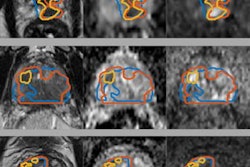
A new type of MRI protocol called synthetic correlated diffusion imaging better visualizes cancerous tissue in the prostate and may help clinicians better identify and track cancer over time, according to a study published on 1 March in Scientific Reports.
Researchers from the University of Waterloo in Ontario, Canada, developed the protocol, which captures, synthesizes, and mixes MRI signals at various pulse strengths and timings, according to a statement released by the university on 21 March. The group tested the technology on 200 patients with prostate cancer and found that it was better than conventional MRI imaging for identifying cancerous tissue.
"Prostate cancer is the second most common cancer in men worldwide and the most frequently diagnosed cancer among men in more developed countries," said lead author Alexander Wong, PhD, in the statement. "That's why we targeted it first in our research. [But] we also have very promising results for breast cancer screening, detection, and treatment planning. This could be a game-changer for many kinds of cancer imaging and clinical decision support."








![Overview of the study design. (A) The fully automated deep learning framework was developed to estimate body composition (BC) (defined as subcutaneous adipose tissue [SAT] in liters; visceral adipose tissue [VAT] in liters; skeletal muscle [SM] in liters; SM fat fraction [SMFF] as a percentage; and intramuscular adipose tissue [IMAT] in deciliters) from MRI. The fully automated framework comprised one model (model 1) to quantify different BC measures (SAT, VAT, SM, SMFF, and IMAT) as three-dimensional (3D) measures from whole-body MRI scans. The second model (model 2) was trained to identify standardized anatomic landmarks along the craniocaudal body axis (z coordinate field), which allowed for subdividing the whole-body measures into different subregions typically examined on clinical routine MRI scans (chest, abdomen, and pelvis). (B) BC was quantified from whole-body MRI in over 66,000 individuals from two large population-based cohort studies, the UK Biobank (UKB) (36,317 individuals) and the German National Cohort (NAKO) (30,291 individuals). Bar graphs show age distribution by sex and cohort. BMI = body mass index. (C) After the performance assessment of the fully automated framework, the change in BC measures, distributions, and profiles across age decades were investigated. Age-, sex-, and height-adjusted body composition reference curves were calculated and made publicly available in a web-based z-score calculator (https://circ-ml.github.io).](https://img.auntminnieeurope.com/mindful/smg/workspaces/default/uploads/2026/05/body-comp.XgAjTfPj1W.jpg?auto=format%2Ccompress&fit=crop&h=112&q=70&w=112)


