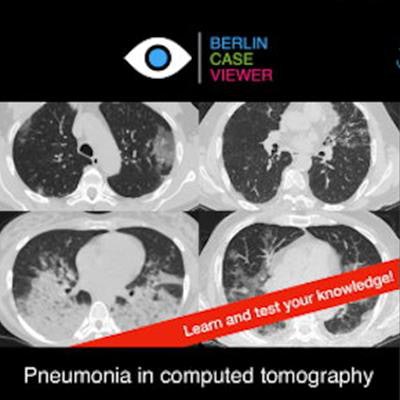
In addition to German and English, the free BerlinCaseViewer app will be available in seven more languages by the autumn, according to an announcement by the developers.
The app, which is designed to train medical imaging professionals in COVID-19 case recognition, will be available in Spanish, French, Chinese, Portuguese, Russian, Romanian, and Greek. Those who would like other languages added should contact the company.
Those who download the app can view relevant cases, the patient's clinical history, and the opportunity to scroll through the entire CT dataset for that patient. Typically, each dataset contains more than 50 slices per case.
Radiologists can access the app for free via the Apple App Store or at berlincaseviewer.de. To get a glimpse of what to expect with the app, view this video.
The BerlinCaseViewer app was the runner-up in the 2021 EuroMinnies award scheme (best new software category).









![Overview of the study design. (A) The fully automated deep learning framework was developed to estimate body composition (BC) (defined as subcutaneous adipose tissue [SAT] in liters; visceral adipose tissue [VAT] in liters; skeletal muscle [SM] in liters; SM fat fraction [SMFF] as a percentage; and intramuscular adipose tissue [IMAT] in deciliters) from MRI. The fully automated framework comprised one model (model 1) to quantify different BC measures (SAT, VAT, SM, SMFF, and IMAT) as three-dimensional (3D) measures from whole-body MRI scans. The second model (model 2) was trained to identify standardized anatomic landmarks along the craniocaudal body axis (z coordinate field), which allowed for subdividing the whole-body measures into different subregions typically examined on clinical routine MRI scans (chest, abdomen, and pelvis). (B) BC was quantified from whole-body MRI in over 66,000 individuals from two large population-based cohort studies, the UK Biobank (UKB) (36,317 individuals) and the German National Cohort (NAKO) (30,291 individuals). Bar graphs show age distribution by sex and cohort. BMI = body mass index. (C) After the performance assessment of the fully automated framework, the change in BC measures, distributions, and profiles across age decades were investigated. Age-, sex-, and height-adjusted body composition reference curves were calculated and made publicly available in a web-based z-score calculator (https://circ-ml.github.io).](https://img.auntminnieeurope.com/mindful/smg/workspaces/default/uploads/2026/05/body-comp.XgAjTfPj1W.jpg?auto=format%2Ccompress&fit=crop&h=112&q=70&w=112)


