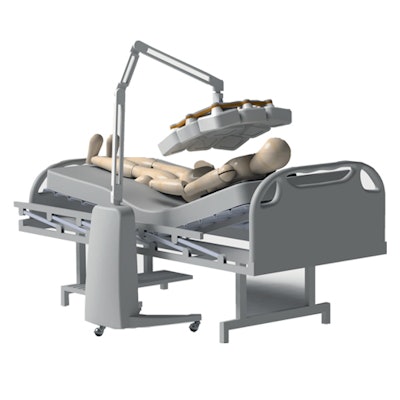
Adaptix, a tech startup based in Oxford, U.K., has revealed details of its point-of-care 3D x-ray system.
The chest imaging device promises mobile 3D imaging at the bedside for a cost and dose similar to existing 2D x-ray systems but better visualization than 2D x-ray of common conditions such as pulmonary edema, pneumothorax/hemothorax, and more confident localization of lines and tubes, the company stated.

The device's lower radiation dose offers the chance for more frequent follow-up 3D imaging, as well as the ability to acquire a 3D image without moving the patient from the bed. It reduces the need to transfer patients within the hospital to access 3D imaging and can lead to lower costs, less risk for the patient, less risk of infecting other patients, and no need for lengthy cleaning of a scanner after imaging an infectious patient, noted the vendor.
The device will be commercially available in 2022. Adaptix says it plans to bring to market "an addressable Flat Panel X-ray Source (FPS) with a multitude of individually addressable emitters with integrated power supply (known as a 'monoblock') – essentially we are 'digitizing' the source to complete the digitization of the imaging system."









![Overview of the study design. (A) The fully automated deep learning framework was developed to estimate body composition (BC) (defined as subcutaneous adipose tissue [SAT] in liters; visceral adipose tissue [VAT] in liters; skeletal muscle [SM] in liters; SM fat fraction [SMFF] as a percentage; and intramuscular adipose tissue [IMAT] in deciliters) from MRI. The fully automated framework comprised one model (model 1) to quantify different BC measures (SAT, VAT, SM, SMFF, and IMAT) as three-dimensional (3D) measures from whole-body MRI scans. The second model (model 2) was trained to identify standardized anatomic landmarks along the craniocaudal body axis (z coordinate field), which allowed for subdividing the whole-body measures into different subregions typically examined on clinical routine MRI scans (chest, abdomen, and pelvis). (B) BC was quantified from whole-body MRI in over 66,000 individuals from two large population-based cohort studies, the UK Biobank (UKB) (36,317 individuals) and the German National Cohort (NAKO) (30,291 individuals). Bar graphs show age distribution by sex and cohort. BMI = body mass index. (C) After the performance assessment of the fully automated framework, the change in BC measures, distributions, and profiles across age decades were investigated. Age-, sex-, and height-adjusted body composition reference curves were calculated and made publicly available in a web-based z-score calculator (https://circ-ml.github.io).](https://img.auntminnieeurope.com/mindful/smg/workspaces/default/uploads/2026/05/body-comp.XgAjTfPj1W.jpg?auto=format%2Ccompress&fit=crop&h=112&q=70&w=112)


