Swiss and German researchers have obtained promising results with a novel PET imaging agent that could help guide and assess treatment for people with various neurological diseases. The preclinical study was published in the April issue of the Journal of Nuclear Medicine.
The agent targets receptors in nerve cells in the brain that are involved in learning and memory, and it could be useful for studying conditions such as Alzheimer's, Parkinson's, and multiple sclerosis (JNM, April 2018, Vol.59:4, pp. 698-703).
The PET radioligand, known as carbon-11 (C-11) Me-NB1, is designed to image GluN1/GluN2B-containing N-methyl-D-aspartate (NMDA) receptors in nerve cells. When NMDA receptors are activated, there is an increase in the level of calcium in the cells. However, if calcium levels are too high, it can lead to cell death.
"We have for the first time developed a useful PET radioligand that can be applied to image the GluN2B receptor subunit of the NMDA receptor complex in humans," said senior author Simon Ametamey, PhD, from the Institute of Pharmaceutical Sciences of ETH Zurich, in a statement from the Society of Nuclear Medicine and Molecular Medicine (SNMMI). "The availability of such a PET radioligand would not only help to better understand the role of NMDA receptors in the pathophysiology of the many brain diseases in which the NMDA receptor is implicated, but it would also help to select appropriate doses of clinically relevant GluN2B receptor candidate drugs."
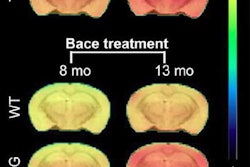
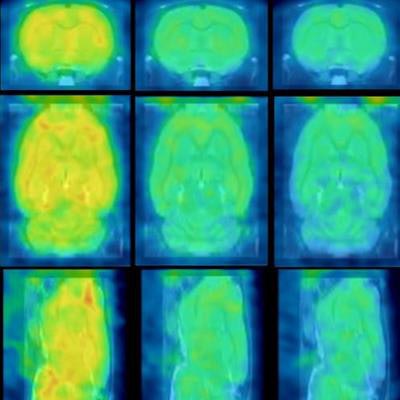
 PET imaging of a rat's brain with C-11 Me-NB1 superimposed on an MRI template. Image courtesy of SNMMI and Krämer et al from ETH Zurich.
For the study, the researchers used C-11 Me-NB1 in live rats to assess the dose and effectiveness of eliprodil, a drug that blocks the NMDA GluN2B receptor. PET images showed that the receptors are fully occupied at neuroprotective doses of eliprodil.
The findings could help direct the use of medications that block NMDA receptors; such medications are used in the treatment of neurological conditions such as depression, neuropathic pain, and schizophrenia, as well as ischemic stroke and dementia.
The radioligand "joins the list of existing PET radiopharmaceuticals used in imaging studies to investigate and understand underlying causes of these brain disorders," Ametamey said. "Furthermore, future imaging studies using this new radioligand would throw more light on the involvement of NMDA receptors, specifically the GluN2B receptors, in normal physiological processes such as learning and memory, as well as accelerate the development of GluN2B candidate drugs currently under development."