The European Society of Radiology's EuroSafe Imaging campaign has reissued a Europe-wide Call for Action to support the World Health Organization (WHO) and International Atomic Energy Agency (IAEA)'s Bonn Call for Action.
The EuroSafe Imaging Call for Action has goals, including:
- Promoting appropriateness in imaging
- Keeping radiation doses within diagnostic reference levels
- Using the as low as reasonably achievable (ALARA) principle
- Encouraging the use of up-to-date equipment
- Empowering patients and joining forces with other stakeholders
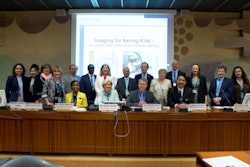
"This initiative is necessary, but also is very timely, because we are now facing, worldwide, a challenge to deal with the potential risks of radiation in healthcare without compromising the benefits, and this is the reason why I think it is very appropriate that this initiative is taken by the professionals; the radiologists," said Dr. Maria Del Rosario Perez from the WHO.
The EuroSafe Imaging campaign is designed to bring radiation exposure from imaging exams to the forefront and the need to keep doses as low as possible.






![Overview of the study design. (A) The fully automated deep learning framework was developed to estimate body composition (BC) (defined as subcutaneous adipose tissue [SAT] in liters; visceral adipose tissue [VAT] in liters; skeletal muscle [SM] in liters; SM fat fraction [SMFF] as a percentage; and intramuscular adipose tissue [IMAT] in deciliters) from MRI. The fully automated framework comprised one model (model 1) to quantify different BC measures (SAT, VAT, SM, SMFF, and IMAT) as three-dimensional (3D) measures from whole-body MRI scans. The second model (model 2) was trained to identify standardized anatomic landmarks along the craniocaudal body axis (z coordinate field), which allowed for subdividing the whole-body measures into different subregions typically examined on clinical routine MRI scans (chest, abdomen, and pelvis). (B) BC was quantified from whole-body MRI in over 66,000 individuals from two large population-based cohort studies, the UK Biobank (UKB) (36,317 individuals) and the German National Cohort (NAKO) (30,291 individuals). Bar graphs show age distribution by sex and cohort. BMI = body mass index. (C) After the performance assessment of the fully automated framework, the change in BC measures, distributions, and profiles across age decades were investigated. Age-, sex-, and height-adjusted body composition reference curves were calculated and made publicly available in a web-based z-score calculator (https://circ-ml.github.io).](https://img.auntminnieeurope.com/mindful/smg/workspaces/default/uploads/2026/05/body-comp.XgAjTfPj1W.jpg?auto=format%2Ccompress&fit=crop&h=112&q=70&w=112)


