Many radiologists are working from home during the COVID-19 pandemic, but how can this be done more efficiently? Dr. Mattias Mjöman, a radiologist at Region Skåne, has described how he's changed his daily work routine.
In a wide-ranging interview published on Sectra's website, Mjöman shared how the pandemic has impacted his work situation, what his workplace looks like at his home, and the pros and cons of this novel way of working.
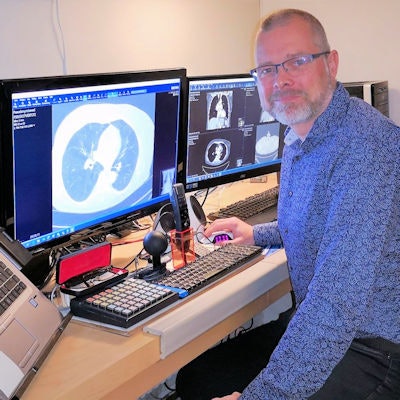
 Mjöman working from home. Image courtesy of Sectra.
His workstation is connected to the central system via a secure VPN tunnel administered by Region Skåne. He uses a regular home fiber connection, with a 100 Mbps download speed and 10 Mbps upload speed. With the VPN connected, the download speed is approximately 35 Mbps.
"This setup works very well for me, and my review performance is as good as it is onsite at the hospital," Mjöman noted. "I also have a special mouse and keyboard that I have configured to be able to steer the dictaphone and use keyboard shortcuts. It makes me more efficient. Altogether, the ergonomics are good -- however, I do miss my height-adjustable desk and the possibility to work while standing."
Some of his colleagues still have to work at the hospitals, but they have taken several actions to minimize the risk of being infected, he explained. Lunch breaks have been redistributed, meetings take place in larger rooms or via Skype, and resident training is no longer taking place at workstations but in multidisciplinary team rooms, for example.
"We have received [COVID-19] cases in order to confirm pneumonia, both CT and [computed radiography] examinations. The intensive care unit and the temporary care stations built contain mobile modalities for COVID-19 diagnostic purposes. These images are imported into the centralized image archive and diagnosed by us," Mjöman said. "Furthermore, the Swedish Society of Radiology (Svensk Förening för Medicinsk Radiologi) has sent out guidelines on how we should work, which has been very good."
The radiology department is currently preparing home-working kits for a broader rollout to enable even more radiologists to work from home should the situation worsen, he concluded.