Dear MRI Insider,
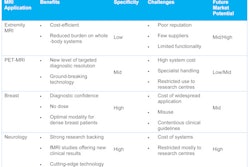
The development of application-focused MRI technology has slowed in recent years, and improvements in scan speed, workflow, and operating cost have had no great impact on clinical diagnosis, according to market analyst Stephen Holloway. But this situation might be about to change, and MRI could finally be on a path toward greater clinical specificity. Click here to find out more.
The protracted and acrimonious dispute about the early days of MRI re-emerged at the European Congress of Radiology on Sunday. Dr. Morton Meyers, a radiologist and historian from East Setauket in New York, remains convinced there should have been a third recipient of the Nobel Prize awarded in 2003 -- but not everybody agrees. Get the story here.
On the same day at ECR 2014, new research was presented about why whole-body MRI screening is safe and accurate for detecting serious pathology in the asymptomatic general population -- especially in patients older than 50. A few findings were more prevalent than expected in individuals younger than 50, however. To learn more, click here.
MRI also featured extensively in the ECR 2014 technical exhibition. Several companies introduced new equipment at the congress in Vienna, and you can read AuntMinnie.com Editor-in-Chief Brian Casey's comprehensive roundup by clicking here.
Meanwhile, researchers in Italy have used 7-tesla MRI to uncover details of an area in the brain linked to Parkinson's disease, which could help improve early detection of the condition. They published their findings online on 26 February in Radiology. Get the details here.
Do we need articles about imaging ingrown toenails at 7 tesla? Of course not, but Dr. Peter Rinck, PhD, is concerned that too many lightweight and trivial papers are being published. Click here to read more.
This letter features only a small selection of the many articles posted in the MRI Digital Community. Check out the rest of them below this message.



![Overview of the study design. (A) The fully automated deep learning framework was developed to estimate body composition (BC) (defined as subcutaneous adipose tissue [SAT] in liters; visceral adipose tissue [VAT] in liters; skeletal muscle [SM] in liters; SM fat fraction [SMFF] as a percentage; and intramuscular adipose tissue [IMAT] in deciliters) from MRI. The fully automated framework comprised one model (model 1) to quantify different BC measures (SAT, VAT, SM, SMFF, and IMAT) as three-dimensional (3D) measures from whole-body MRI scans. The second model (model 2) was trained to identify standardized anatomic landmarks along the craniocaudal body axis (z coordinate field), which allowed for subdividing the whole-body measures into different subregions typically examined on clinical routine MRI scans (chest, abdomen, and pelvis). (B) BC was quantified from whole-body MRI in over 66,000 individuals from two large population-based cohort studies, the UK Biobank (UKB) (36,317 individuals) and the German National Cohort (NAKO) (30,291 individuals). Bar graphs show age distribution by sex and cohort. BMI = body mass index. (C) After the performance assessment of the fully automated framework, the change in BC measures, distributions, and profiles across age decades were investigated. Age-, sex-, and height-adjusted body composition reference curves were calculated and made publicly available in a web-based z-score calculator (https://circ-ml.github.io).](https://img.auntminnieeurope.com/mindful/smg/workspaces/default/uploads/2026/05/body-comp.XgAjTfPj1W.jpg?auto=format%2Ccompress&fit=crop&h=100&q=70&w=100)


![Overview of the study design. (A) The fully automated deep learning framework was developed to estimate body composition (BC) (defined as subcutaneous adipose tissue [SAT] in liters; visceral adipose tissue [VAT] in liters; skeletal muscle [SM] in liters; SM fat fraction [SMFF] as a percentage; and intramuscular adipose tissue [IMAT] in deciliters) from MRI. The fully automated framework comprised one model (model 1) to quantify different BC measures (SAT, VAT, SM, SMFF, and IMAT) as three-dimensional (3D) measures from whole-body MRI scans. The second model (model 2) was trained to identify standardized anatomic landmarks along the craniocaudal body axis (z coordinate field), which allowed for subdividing the whole-body measures into different subregions typically examined on clinical routine MRI scans (chest, abdomen, and pelvis). (B) BC was quantified from whole-body MRI in over 66,000 individuals from two large population-based cohort studies, the UK Biobank (UKB) (36,317 individuals) and the German National Cohort (NAKO) (30,291 individuals). Bar graphs show age distribution by sex and cohort. BMI = body mass index. (C) After the performance assessment of the fully automated framework, the change in BC measures, distributions, and profiles across age decades were investigated. Age-, sex-, and height-adjusted body composition reference curves were calculated and made publicly available in a web-based z-score calculator (https://circ-ml.github.io).](https://img.auntminnieeurope.com/mindful/smg/workspaces/default/uploads/2026/05/body-comp.XgAjTfPj1W.jpg?auto=format%2Ccompress&fit=crop&h=112&q=70&w=112)