Dear MRI Insider,
Will ultrahigh-field MRI at 7 tesla eventually replace standard imaging at 1.5 to 3.0 tesla within the next 10 years? This question probably divides the global MRI community more than any other. If you were to ask a cross section of modality specialists for an answer, you're virtually guaranteed to get a totally diverse set of replies.
One person with very few doubts, however, is Dr. Thoralf Niendorf, PhD, from Berlin. For his latest thinking on the benefits and clinical potential of ultrahigh-field MR, go to our MRI Digital Community, or click here.
Growing numbers of people are turning to the Internet for training and education about MRI. There's now a wide range of online resources to choose from, as staff writer Rebekah Moan discovered. Read her story here.
New advances in MRI featured prominently at the German Radiological Society's annual meeting, the DRK, held in Hamburg a fortnight ago. Make sure you don't miss our two important news reports from the DRK about the latest developments in high-field MRI microscopy, as well as carotid plaque imaging in stroke.
MR elastography measures the properties of tissues through low-frequency waves that induce stress, and it can help distinguish between malignant and benign liver tumors. Researchers from Paris now think the modality can be used to evaluate the shear properties of the tissues. To find out more, click here.
Researchers from a top London hospital have compiled an overview of the imaging appearances of gynecological emergencies in nonpregnant patients, and they found MRI is particularly useful for identifying the site of origin of large pelvic masses such as torsion. Click here to learn more about their experiences.
Pacemakers and MRI remains a hot topic, and new guidance has been issued in this controversial area. Get the story here.

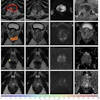


![Overview of the study design. (A) The fully automated deep learning framework was developed to estimate body composition (BC) (defined as subcutaneous adipose tissue [SAT] in liters; visceral adipose tissue [VAT] in liters; skeletal muscle [SM] in liters; SM fat fraction [SMFF] as a percentage; and intramuscular adipose tissue [IMAT] in deciliters) from MRI. The fully automated framework comprised one model (model 1) to quantify different BC measures (SAT, VAT, SM, SMFF, and IMAT) as three-dimensional (3D) measures from whole-body MRI scans. The second model (model 2) was trained to identify standardized anatomic landmarks along the craniocaudal body axis (z coordinate field), which allowed for subdividing the whole-body measures into different subregions typically examined on clinical routine MRI scans (chest, abdomen, and pelvis). (B) BC was quantified from whole-body MRI in over 66,000 individuals from two large population-based cohort studies, the UK Biobank (UKB) (36,317 individuals) and the German National Cohort (NAKO) (30,291 individuals). Bar graphs show age distribution by sex and cohort. BMI = body mass index. (C) After the performance assessment of the fully automated framework, the change in BC measures, distributions, and profiles across age decades were investigated. Age-, sex-, and height-adjusted body composition reference curves were calculated and made publicly available in a web-based z-score calculator (https://circ-ml.github.io).](https://img.auntminnieeurope.com/mindful/smg/workspaces/default/uploads/2026/05/body-comp.XgAjTfPj1W.jpg?auto=format%2Ccompress&fit=crop&h=100&q=70&w=100)


![Overview of the study design. (A) The fully automated deep learning framework was developed to estimate body composition (BC) (defined as subcutaneous adipose tissue [SAT] in liters; visceral adipose tissue [VAT] in liters; skeletal muscle [SM] in liters; SM fat fraction [SMFF] as a percentage; and intramuscular adipose tissue [IMAT] in deciliters) from MRI. The fully automated framework comprised one model (model 1) to quantify different BC measures (SAT, VAT, SM, SMFF, and IMAT) as three-dimensional (3D) measures from whole-body MRI scans. The second model (model 2) was trained to identify standardized anatomic landmarks along the craniocaudal body axis (z coordinate field), which allowed for subdividing the whole-body measures into different subregions typically examined on clinical routine MRI scans (chest, abdomen, and pelvis). (B) BC was quantified from whole-body MRI in over 66,000 individuals from two large population-based cohort studies, the UK Biobank (UKB) (36,317 individuals) and the German National Cohort (NAKO) (30,291 individuals). Bar graphs show age distribution by sex and cohort. BMI = body mass index. (C) After the performance assessment of the fully automated framework, the change in BC measures, distributions, and profiles across age decades were investigated. Age-, sex-, and height-adjusted body composition reference curves were calculated and made publicly available in a web-based z-score calculator (https://circ-ml.github.io).](https://img.auntminnieeurope.com/mindful/smg/workspaces/default/uploads/2026/05/body-comp.XgAjTfPj1W.jpg?auto=format%2Ccompress&fit=crop&h=112&q=70&w=112)