
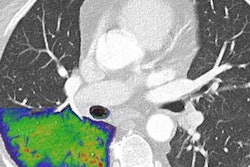
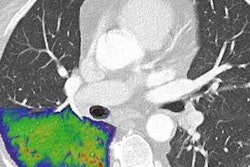
Photon-counting CT shows promise for better diagnostic performance compared to conventional CT, according to research presented on Sunday at the RSNA 2021 meeting.
"It has the potential for better contrast and noise performance compared to scintillator-based energy integration detector [CT]," presenter Richard Thompson, PhD, of Canon Medical Research Institute USA in Vernon Hills, IL, told session attendees.
Thompson and colleagues conducted a study using a phantom to compare image quality between a prototype photon-counting CT device and a conventional CT system, analyzing for noise, spatial resolution, and accuracy.
The photon-counting prototype was based on a Canon Aquilion One Vision system. Its smallest detector pixel size is 342 µm; each pixel produces measurements of up to six energy bins starting from 20 keV, Thompson said. (Photon-counting detectors generate energy-specific images that are assigned to energy bins in small ranges.)
The investigators scanned a 40-cm water phantom and Sun Nuclear's Gammex multienergy phantom with both the photon-counting prototype and the conventional scanner, comparing both counting and spectral images. The photon-counting CT device produced images with 20% to 25% reduced noise compared to conventional CT and had higher spatial resolution, from 0.60 lp/mm for conventional CT to 0.69 lp/mm for the photon-counting device.
"The initial performance of this prototype photon-counting CT system in both counting and spectral imaging modes demonstrates its potential to achieve better diagnostic performance with reduced dose," Thompson concluded.








![Overview of the study design. (A) The fully automated deep learning framework was developed to estimate body composition (BC) (defined as subcutaneous adipose tissue [SAT] in liters; visceral adipose tissue [VAT] in liters; skeletal muscle [SM] in liters; SM fat fraction [SMFF] as a percentage; and intramuscular adipose tissue [IMAT] in deciliters) from MRI. The fully automated framework comprised one model (model 1) to quantify different BC measures (SAT, VAT, SM, SMFF, and IMAT) as three-dimensional (3D) measures from whole-body MRI scans. The second model (model 2) was trained to identify standardized anatomic landmarks along the craniocaudal body axis (z coordinate field), which allowed for subdividing the whole-body measures into different subregions typically examined on clinical routine MRI scans (chest, abdomen, and pelvis). (B) BC was quantified from whole-body MRI in over 66,000 individuals from two large population-based cohort studies, the UK Biobank (UKB) (36,317 individuals) and the German National Cohort (NAKO) (30,291 individuals). Bar graphs show age distribution by sex and cohort. BMI = body mass index. (C) After the performance assessment of the fully automated framework, the change in BC measures, distributions, and profiles across age decades were investigated. Age-, sex-, and height-adjusted body composition reference curves were calculated and made publicly available in a web-based z-score calculator (https://circ-ml.github.io).](https://img.auntminnieeurope.com/mindful/smg/workspaces/default/uploads/2026/05/body-comp.XgAjTfPj1W.jpg?auto=format%2Ccompress&fit=crop&h=112&q=70&w=112)


