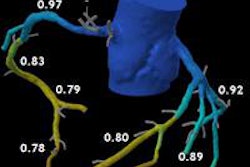
Cardiac software developer HeartFlow is promoting a study at this week's EuroPCR 2015 meeting in Paris on the use of its fractional flow reserve (FFR) CT analysis software to assess the severity of coronary artery stenosis.
Treatment management changed in more than one-third of the 200 patients in the study, lead author Dr. Nick Curzen, PhD, from University Hospital Southampton in the U.K., and colleagues found.
The study showed that FFR-CT with coronary CT angiography could become the gold standard for initial assessment of patients with suspected coronary artery disease by evaluating coronary anatomy and physiology at the same time, Curzen said.
Invasive fractional flow reserve is considered the gold standard in diagnosing functionally significant coronary artery disease; however, it is invasive and expensive. An FFR-directed percutaneous coronary intervention (PCI) approach has been shown to lead to better outcomes than angiography-directed PCI, the authors wrote.
In all, treatment management was changed in 36% of patients (72 of 200), the group reported. Moreover, in 16 (18%) of the 87 cases considered candidates for PCI based on angiography, one or more target lesions were changed using HeartFlow.
In addition to the current study, two other important studies have now validated the accuracy of FFR-CT analysis in determining noninvasively whether a lesion is restricting blood flow to the heart, HeartFlow said.








![Overview of the study design. (A) The fully automated deep learning framework was developed to estimate body composition (BC) (defined as subcutaneous adipose tissue [SAT] in liters; visceral adipose tissue [VAT] in liters; skeletal muscle [SM] in liters; SM fat fraction [SMFF] as a percentage; and intramuscular adipose tissue [IMAT] in deciliters) from MRI. The fully automated framework comprised one model (model 1) to quantify different BC measures (SAT, VAT, SM, SMFF, and IMAT) as three-dimensional (3D) measures from whole-body MRI scans. The second model (model 2) was trained to identify standardized anatomic landmarks along the craniocaudal body axis (z coordinate field), which allowed for subdividing the whole-body measures into different subregions typically examined on clinical routine MRI scans (chest, abdomen, and pelvis). (B) BC was quantified from whole-body MRI in over 66,000 individuals from two large population-based cohort studies, the UK Biobank (UKB) (36,317 individuals) and the German National Cohort (NAKO) (30,291 individuals). Bar graphs show age distribution by sex and cohort. BMI = body mass index. (C) After the performance assessment of the fully automated framework, the change in BC measures, distributions, and profiles across age decades were investigated. Age-, sex-, and height-adjusted body composition reference curves were calculated and made publicly available in a web-based z-score calculator (https://circ-ml.github.io).](https://img.auntminnieeurope.com/mindful/smg/workspaces/default/uploads/2026/05/body-comp.XgAjTfPj1W.jpg?auto=format%2Ccompress&fit=crop&h=112&q=70&w=112)


