I have long seen Marie Curie as a passionate and exciting person, and not the dry and austere scientist as she is presented in the popular imagination. Her passionate nature comes across in her relationships with her husband Pierre Curie and with her lover Paul Langevin, who had been Pierre's student.
I was delighted to be able to attend the U.K. premiere of Alan Alda's "Radiance: The Passion of Marie Curie"1 at The Tabard Theatre in West London, which was directed by the veteran New York and London producer/director Mark Giesser.2 The cast features Cathy Tyson (Marie Curie), James Palmer (Paul Langevin), Clive Moore (Pierre Curie), Zoë Teverson (Jeanne Langevin), John Albasiny (Emile Perrin), Zoë Simon (Marguerite Borel), and Stephen Cavanagh (Terbougie/H R Tornebladh).
_Richard_2015_02_24_history_Davenport_4-_Cathy_Tyson_and_Clive_Moore.png?auto=format%2Ccompress&dpr=2&fit=max&q=70&w=700) Cathy Tyson (Marie Curie) and Clive Moore (Pierre Curie) from "Radiance." Copyright Richard Davenport.
Cathy Tyson (Marie Curie) and Clive Moore (Pierre Curie) from "Radiance." Copyright Richard Davenport.Five years after the death of Pierre Curie, Marguerite Borel suspected there was a relationship developing between Marie Curie and Paul Langevin.3 This was an important time for Marie because she was a candidate for membership of the Académie des Sciences. The Académie des Sciences was very traditional and a woman had never been elected, so her decision to apply was immediately front-page news.
There was a media frenzy with personal attacks on Marie Curie including the claim that all of her important discoveries were made by Pierre. The conflict became quite heated with the liberal, feminist, and anticlerical elements supporting Marie Curie, and a nationalist, pro-Catholic and anti-Semitic, right-wing supporting Edouard Branley. The election took place on 23 January 1911, and Marie lost by a narrow margin. She was very disappointed and never stood again for membership of the Académie des Sciences.
In the spring of 1911, a thief broke into Paul Langevin's study and stole some letters that implied a close relationship between Marie and Paul. The relationship between Langevin and his wife was poor and after an argument he took their two boys out of the family house. Jeanne Langevin claimed she had been struck for cooking badly.
_Richard_Davenport_9_-_Cathy_Tyson_and_Clive_Moore.png?auto=format%2Ccompress&dpr=2&fit=max&q=70&w=700) Cathy Tyson (Marie Curie) and Clive Moore (Pierre Curie) from "Radiance." Copyright Richard Davenport.
Cathy Tyson (Marie Curie) and Clive Moore (Pierre Curie) from "Radiance." Copyright Richard Davenport.That Paul took the children without Jeanne's knowledge of their whereabouts made him liable for a lawsuit.
When Marie Curie was in Brussels with Paul attending the Solvay conference, the rumors became a fully grown scandal. A Parisian newspaper, Le Journal, had a front-page article" "A Story of Love: Madame Curie and Professor Langevin." The article was deadly and Jeanne was presented as a mistreated wife who had only gone to the press because of her children. Marie Curie was depicted as a woman who was engaged in the male practice of science, and as someone who had stolen another woman's husband and destroyed her family.
In 1911, Marie was nominated for a second and unprecedented Nobel Prize, and this was to be for chemistry. The Nobel Prize was for her work in obtaining pure metallic radium, and for the medical use of radium in the treatment of malignancy. However, the Nobel Academy was concerned by the scandal and was reassured by a denial from Marie Curie. What is interesting is that when Marie Curie received her first Nobel Prize, sharing it with Pierre Curie and Henri Becquerel, there was a great deal of publicity from the newspapers. It was completely different for this second Nobel Prize and there was almost complete silence.
Jeanne Langevin concocted a scheme to blackmail her husband, to ensure that he gave up custody of the children and to pay her 1,000 French francs a month. She said he was "consorting with a concubine." On 23 November 1911, extracts from the stolen letters were published and the French public was incensed. Marie was portrayed as a foreigner who was harming a respectable Frenchwoman. Crowds gathered around Marie's house shouting abuse and the children had to be removed to safety. A total of five duels were fought over the Langevin/Curie affair including one between Paul and the journalist Gustave Téry, who had called Langevin a cad and a scoundrel.
_Richard_Davenport_27_-_Zoe_Simon,_Cathy_Tyson_and_John_Albasiny.png?auto=format%2Ccompress&dpr=2&fit=max&q=70&w=700) Zoe Simon (Marguerite Borel), Cathy Tyson (Marie Curie) and John Albasiny from "Radiance." Copyright Richard Davenport.
Zoe Simon (Marguerite Borel), Cathy Tyson (Marie Curie) and John Albasiny from "Radiance." Copyright Richard Davenport.Marie had believed that as a scientist her private life was her own concern; however this proved to be far from the truth. Marie herself wanted the case to go to trial believing that her name would be vindicated; however Paul admitted he was in the wrong made a cash settlement to his wife who also had custody of the children. It is worth noting that when they were teenagers the boys both lived with their father, and also that many years later Marie's granddaughter married Paul's grandson.
In the public mind, that Marie Curie had taken another woman's husband was of more importance than her scientific discoveries, no matter how great. Marie went to Stockholm for the Nobel ceremony, and following this, her health broke down with a severe renal infection that required surgery. She became depressed and her friends even thought she might kill herself. When the Great War broke out in 1914, Marie devoted her energies to supporting her adopted country4 of France, although she received no formal honor from the authorities.
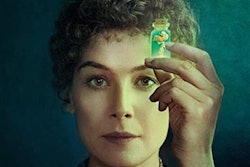
This story is told by Alan Alda in a sensitive and passionate manner, and Cathy Tyson gave a convincing and engaging performance as Marie Curie. My attention was held throughout and the production is warmly recommended. This is an important episode in the life of probably the greatest woman scientist, and one that gives a great insight into her nature. If at all possible, see this play -- you will have a rewarding evening.
Dr. Adrian Thomas is chairman of the International Society for the History of Radiology and honorary librarian at the British Institute of Radiology.
References
- Alda A. Radiance: The Passion of Marie Curie. London, U.K.: Samuel French; 2013.
- "Radiance: The Passion of Marie Curie." Tabard Theatre. London, UK. 4-28 February 2015. www.tabardtheatre.co.uk.
- Ogilvie M. Marie Curie: A Biography. Santa Barbara, CA: Greenwood Press; 2004.
- Thomas A. Marie Curie and the Great War. AuntMinnieEurope.com. http://www.auntminnieeurope.com/index.aspx?sec=sup&sub=xra&pag=dis&ItemID=610041. 23 June 2014.
The comments and observations expressed herein do not necessarily reflect the opinions of AuntMinnieEurope.com, nor should they be construed as an endorsement or admonishment of any particular vendor, analyst, industry consultant, or consulting group.