Using CT to image mummies from four different geographical regions -- and spanning 4,000 years of human history -- researchers have found that heart disease was common among ancient people, according to a study published online on Sunday in Lancet.
 |
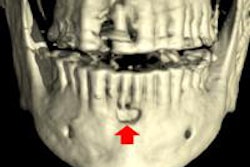
| Coronal 3D volume-rendered CT reconstruction showing carotid artery disease. All images courtesy of Lancet. |
Lead author Dr. Randall Thompson, from Saint Luke's Mid America Heart Institute in Kansas City, MO, and colleagues found signs of vascular calcification where the mummies' arterial structure had survived. In some cases, the arterial structure had not survived mummification, but the calcified plaque was still present in sites where arteries would have once been (Lancet, March 10, 2013).
Of the 137 mummies, 47 (34%) showed probable or definite atherosclerosis, according to Thompson's team, in all four geographical populations:
- 29 (38%) of 76 ancient Egyptians
- 13 (25%) of 51 ancient Peruvians
- 2 (40%) of 5 Ancestral Puebloans
- 3 (60%) of 5 Unangan hunter-gatherers
The researchers found heart disease in the aorta in 20% of the mummies, in the iliac or femoral arteries in 18%, in the popliteal or tibial arteries in 18%, in the carotid arteries in 12%, and in the coronary arteries in 4%.
Age at time of death corresponded to the presence of atherosclerosis, according to Thompson and colleagues. The mean age at death was 43 years for mummies with heart disease and 32 years for those without.
Although previous research has revealed heart disease in Egyptian mummies, this is the first study to look for the signs of arterial hardening in mummies from varied cultures and regions, with different lifestyles and living at different times, according to the authors.
 |
| Coronal 3D volume-rendered CT reconstructions of mummies with calcifications in the distal aorta and iliac arteries. Above, aortic and iliac calcification in the mummy of an Egyptian woman; below, aortic and iliac calcification in the mummy of a woman from ancient Peru. |
 |
"The fact that we found similar levels of atherosclerosis in all of the different cultures we studied, all of whom had very different lifestyles and diets, suggests that atherosclerosis may have been far more common in the ancient world than previously thought," he said in a statement released by Lancet.
"Furthermore, the mummies we studied from outside Egypt were produced naturally as a result of local climate conditions, meaning that it's reasonable to assume that these mummies represent a reasonable cross-section of the population, rather than the specially selected elite group of people who were selected for mummification in ancient Egypt," he said.