
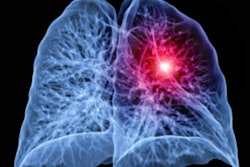
Dutch artificial intelligence (AI) software developer Aidence is highlighting newly published research that found its computer-aided detection (CAD) software reduced radiologist reading time by an average of approximately 40% when reporting pulmonary nodules on CT exams.
In a study published on 2 August in European Journal of Radiology Open, two radiologists from Spaarne Gasthuis in the Netherlands independently assessed 50 chest CT scans for incidental pulmonary nodules first on their own and then, six months later, with assistance from Aidence's Veye Lung Nodules software.
The first reader read the cases 33.4% faster with the software, while the second radiologist was 42.6% faster. What's more, the two readers increased their level of agreement for patient recommendations from a linear weighted kappa of 0.61 to 0.84 after using the software.






![A normal mammogram confirmed by three-year radiologic follow-up illustrates reader-marked regions of interest (ROIs) during (A) unaided (round 1) and (B) artificial intelligence (AI)–assisted (round 2) reading. Each colored dot represents an ROI for recall by a human reader. Readers could mark more than one ROI per case, represented by multiple dots of the same color. During AI-assisted reading, the AI system displayed three visible prompts: two with suspicion of malignancy scores of 35% (left mediolateral oblique [L MLO] and craniocaudal [L CC]) and one with a suspicion of malignancy score of 10% (right craniocaudal [R CC]), shown as polygonal overlays. Without AI, six of 10 readers (60%) marked a false-positive ROI. With AI assistance, this fell to two of 10 (20%). R MLO = right mediolateral oblique.](https://img.auntminnieeurope.com/mindful/smg/workspaces/default/uploads/2026/07/2026-07-14-radiology-mammogram-ai-auto-bias.H0bYO8QlWs.jpg?auto=format%2Ccompress&fit=crop&h=112&q=70&w=112)


