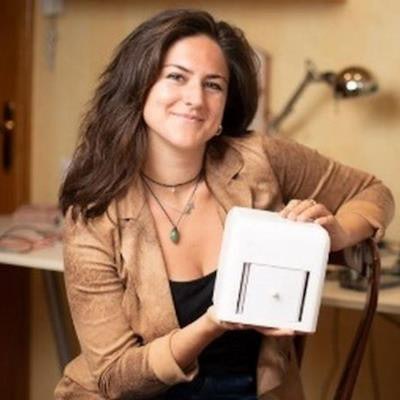
The Blue Box, a home testing kit for breast cancer, has won the first prize in the international James Dyson Award, which means a 30,000 pound (33,730 euro) cash windfall for the 23-year-old Spanish developer, according to a BBC News report.
Designed by Judit Giró Benet, the device performs chemical analysis of urine samples and sends the results for testing. An artificial intelligence (AI)-based algorithm reacts to specific metabolites in the urine, which then provides the user with a fast diagnosis. Because the Blue Box is connected to a smartphone app, test takers can be put into contact with a medical professional if they test positive for breast cancer.
 Judit Giró Benet holding the Blue Box. Image courtesy of Dyson.
Along with her colleagues, Benet will develop prototypes and data analytics software at the University of California, Irvine, U.S. Before hitting the retail market, the device will require rigorous trials and approvals.